The language of events
Course · Mathematics (Grade 11 Humanities, Lebanon), chapter 10 · Lebanon, Grade 11 Humanities · the beginning of the chapter, the rest on Adloun
What will the weather be like tomorrow? Which side will the coin show at the toss before a match? Which ticket will come out of the raffle urn? In all these situations, we know in advance the list of possible results, but we cannot say which one will occur: chance decides.
Before measuring the chances that a result occurs, we must know how to talk about it precisely. This chapter sets up the vocabulary: the random experiment, its outcomes, its sample space, then events and the words that connect them, “complement”, “and”, “or”, “incompatible”. No calculation of chances is made in it; we only learn to describe, list and count the possible results.
Curriculum: LB-1H
Required skills
- Recognize a random experiment; describe its outcomes and its sample space with a list, a tree or a table.
- Count the outcomes of a sample space.
- Write an event as a set of outcomes and say whether it occurs.
- Recognize an elementary event, the certain event, the impossible event.
- Determine the complementary event of an event, the event “ and ”, the event “ or ”.
- Recognize two incompatible events, and distinguish them from two complementary events.
10.1 Basic terminology
10.1.1 Random experiment
A die is rolled on a table. Before the roll, we know that the top face will carry one of the numbers , , , , or ; but we cannot know which one. If we start again, the result may change. Such an experiment is called random (in French aléatoire, from a Latin word that means the game of dice).
A random experiment is an experiment that satisfies two conditions:
- all the possible results are known in advance;
- we cannot predict which of these results will occur.
- Tossing a coin and looking at the visible side: random experiment (two possible results, “tails” or “heads”, unpredictable).
- Drawing a ticket, eyes closed, from the urn of a raffle: random experiment.
- Questioning a person chosen at random in the street and asking for their month of birth: random experiment.
- Dropping a stone and watching whether it falls: this is not a random experiment, because the result is known in advance.
10.1.2 Outcome and sample space
- Each possible result of a random experiment is called an outcome.
- The set of all the outcomes is called the sample space (or universe) of the experiment. It is denoted (capital Greek letter “omega”).
The sample space is written between braces, separating the outcomes with commas. The order in which they are written does not matter.
- A die is rolled and the number on the top face is read: . The sample space has outcomes.
- A coin is tossed: , or more briefly . The sample space has outcomes.
- A day of the week is chosen at random: . The sample space has outcomes.
With the same die, we can decide to write down only whether the number is even or odd. The sample space is then : it has only outcomes. Before describing a sample space, we must therefore read carefully what is written down at the end of the experiment.
10.1.3 Describing a sample space: list, tree, table
When the experiment is done in a single stage, a simple list is enough. When it is done in several stages, there is a risk of forgetting outcomes: a tree or a table makes it possible to miss none.
With a tree. A coin is tossed twice in a row and the two results are written down in order. The tree below carries one branch per result of the first toss, then, at the end of each one, one branch per result of the second.
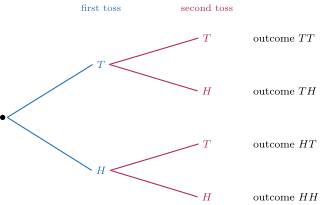
Each path, from the starting point to the end of a branch, is an outcome. The sample space is : it has outcomes. The outcomes (tails, then heads) and (heads, then tails) are different: the order of the tosses matters.
With a table. Two dice, one red and the other blue, are rolled and the number of each is written down. An outcome is an ordered pair, such as : the red die shows and the blue die shows . The outcomes are arranged in a two-way table: one row per number of the red die, one column per number of the blue die.
| red blue | ||||||
|---|---|---|---|---|---|---|