Arrangements and permutations
Course · Mathematics (Grade 11 Humanities, Lebanon), chapter 9 · Lebanon, Grade 11 Humanities · the beginning of the chapter, the rest on Adloun
How many different codes can be set on a padlock with three dials? In how many ways can eight runners share the three steps of a podium? In what order should the five bands of a concert perform, and how many orders are possible? To answer, there is no question of writing out every possibility one by one: they quickly number in the hundreds, then in the thousands.
This chapter teaches how to count, that is, how to count without listing everything. A single idea is enough: when several choices are made one after another, the numbers of possibilities multiply. It leads to a new notation, the factorial, then to three standard situations, which are told apart by two simple questions: are we arranging all the objects or only some of them? Can the same one be taken several times?
Curriculum: LB-1H
Required skills
- Count successive choices with a tree or a product.
- Calculate a factorial and simplify a quotient of factorials.
- Count the permutations of objects.
- Count arrangements with repetition ().
- Count arrangements without repetition ().
- Recognize, in a concrete situation, which of these three counts applies.
9.1 Factorial
9.1.1 Counting successive choices
A canteen offers starters (hummus or tabbouleh) and main dishes (chicken, fish or stuffed vegetables). How many different meals, made up of one starter and one main dish, can be put together? The choices are represented by a tree: one branch per starter, then, at the end of each, one branch per main dish.
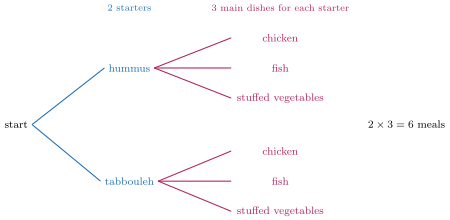
Each path, from the start to the end of a branch, is a meal. There are starters and, for each one, main dishes: in all meals. If we add the choice of a dessert from , each meal extends in ways: complete meals. The tree becomes too big to draw, but the product is enough.
If several choices are made one after another, with possibilities for the first choice, then possibilities for the second, then for the third, and so on, then the total number of outcomes is the product
With shirts, pairs of trousers and pairs of shoes, different outfits can be put together.
9.1.2 The factorial notation
We want to hang photos side by side on a wall. For the left-hand place, we can choose any of the photos. For the middle place, only are left. For the right-hand place, only one is left. By the multiplication principle, there are ways to hang them. With photos, we would find ways.
These products of consecutive integers come up again and again in counting. They have been given a name and a notation.
Let be a natural number, with . The factorial of , denoted , is the product of all the integers from to :
By convention, .
The notation is read “ factorial”. The product can be written in any order: .
Factorials grow very fast: is already more than three million. This is why we avoid calculating them in full when they can be simplified.
9.1.3 Calculating with factorials
To go from one factorial to the next, it is enough to multiply by a single number: , since .
For every natural number :
This relation explains the convention : for , it gives , which is true with .
Method : Simplifying a quotient of factorials
- Spot the smaller of the two factorials.
- Write the larger one, stopping at the smaller one: for example .
- Cancel the common factorial, then calculate the remaining product.
- .
- .
- . No calculator can display , and yet the quotient is immediate.
- The other way round: .