Calculating probabilities
Course · Mathematics (Grade 11 Humanities, Lebanon), chapter 12 · Lebanon, Grade 11 Humanities · the beginning of the chapter, the rest on Adloun
In a class, students play a sport and play a musical instrument. If a person is chosen at random, what is the probability that they do one or the other? We cannot answer by simply adding and : some students do both, and they would be counted twice.
This chapter gives the rules that make it possible to calculate the probability of an event from other probabilities already known: that of “ or ”, that of the union of two incompatible events, that of a complementary event. It then presents three tools for organizing a calculation: the two-way table, the tree and counting by arrangements and permutations.
Curriculum: LB-1H
Required skills
- Calculate the probability of “ or ” with the formula .
- Recognize two incompatible events and add their probabilities.
- Calculate the probability of a complementary event; use it for “at least one”.
- Read and complete a two-way table to calculate probabilities.
- Draw a simple tree to list equiprobable outcomes.
- Calculate a probability by counting with arrangements or permutations.
Throughout the chapter, denotes the probability of an event . Recall that, when the outcomes are equiprobable, .
12.1 Events “ and ”, “ or ”
12.1.1 An example to begin with
The event “ and ”, denoted , occurs when and both occur. The event “ or ”, denoted , occurs when at least one of the two occurs.
Let us go back to the class of the introduction (data made up for the example). It has students: play a sport, play an instrument, and do both. A person is chosen at random from the class. Let be the event “the person plays a sport” and the event “the person plays an instrument”.
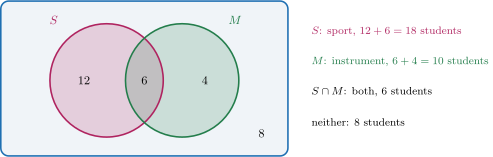
The diagram splits the students into four groups: do only sport, do both, do only music, and do neither ().
- and .
- “ and ”: students do both, so .
- “ or ”: students do at least one of the two activities, so .
If we add and , we find , not . The difference, , is exactly : the students who do both activities were counted twice, once with sport, once with music. They must be taken away once:
12.1.2 The formula
For all events and of the same sample space:
Proof
We place ourselves in an equiprobable situation. To count the outcomes of , we add the number of outcomes of and the number of outcomes of ; the common outcomes, those of , are then counted twice. We take them away once:
It remains to divide both sides by . We accept that the formula remains true when the outcomes are not equiprobable.
Ten cards carry the numbers from to . One is drawn at random. Let : “the number is even” and : “the number is greater than ”.
- , so .
- , so .
- , so .
The formula gives . Check with the list: does have outcomes.
In a town, of households subscribe to an online movie service, to an online music service, and to both (data made up for the example). A household is chosen at random. The probability that it subscribes to at least one of the two services is
12.1.3 Using the formula the other way round
The formula links four probabilities. As soon as three of them are known, the fourth is found. In particular:
In a club, a person is chosen at random. The probability that they speak English is ; the probability that they speak Arabic is ; the probability that they speak at least one of these two languages is . The probability that they speak both languages is
Method : Calculating
- Find , and in the statement: the word “and” (or “both”, “at the same time”) signals .
- Apply .
- Check: the result is between and , and it is at least equal to and to .
12.2 Incompatible events
Two events are incompatible when they have no outcome in common: . The event “ and ” is then impossible, and its probability is . The previous formula simplifies.
If and are incompatible, then
A fair die is rolled. Let : “getting or ” and : “getting ”. The two events are incompatible. So
The rule extends to three or more events, provided they are pairwise incompatible: we add their probabilities.
In a population, a person is chosen at random and their blood group is written down. The probabilities are given by the table (data made up for the example, of a realistic order of magnitude).
| Group | O | A | B | AB |
|---|---|---|---|---|
| Probability |
A person has only one group: the four events are pairwise incompatible. The probability that the person is in group A or group B is . The probability that they are in group O, A or B is .
Exercises of the chapter
- Applying the calculation rules solved
- Counting in a diagram solved
- Going through the complementary event solved
- A two-way table solved
- A tree for two draws solved
- Counting to calculate solved