Arithmetic sequences
Course · Mathematics (Grade 11 Humanities, Lebanon), chapter 13 · Lebanon, Grade 11 Humanities · the beginning of the chapter, the rest on Adloun
In an open-air theater, the first row has seats, and each row has seats more than the previous row: , , , … How many seats does the fifteenth row have? And how many spectators can sit in all on the fifteen rows? We can write the fifteen numbers and add them one by one, but it is long, and it would be much worse with a hundred rows.
A list of numbers in which we always go from one number to the next by adding the same quantity is called an arithmetic sequence. This chapter sets up the vocabulary of sequences, then gives two formulas: one calculates any term of the list directly, the other adds up as many terms as we want in one go.
Curriculum: LB-1H
Required skills
- Use the vocabulary and notation of sequences: term, index, , .
- Recognize an arithmetic sequence and give its common difference.
- Calculate the term of index of an arithmetic sequence.
- Recognize three consecutive terms of an arithmetic sequence.
- Calculate the sum of consecutive terms of an arithmetic sequence.
13.1 Definition
13.1.1 The vocabulary of sequences
Let us go back to the theater. To each row corresponds a number of seats:
| Row number | … | |||||
|---|---|---|---|---|---|---|
| Number of seats | … |
These numbers, arranged in a precise order and numbered, form a sequence. To refer to them without writing them again, we choose a letter, for example , and write the number at the bottom right: , , …
A numerical sequence is an ordered list of numbers, numbered by integers.
- Each number of the list is a term of the sequence; its number is its index.
- The term of index is denoted , which is read “ sub ”.
- The whole sequence is denoted , with parentheses.
Depending on the situation, we number from (the first term is then ) or from (the first term is then ).
If is a term, the one that follows it is and the one that precedes it is . For example, the term that follows is .
In the theater, : row has seats. The term that follows is ; the one that precedes it is .
The expression denotes the term following ; the expression denotes the number to which is added. In the theater, , whereas .
A sequence can be given by a formula that calculates from .
Consider the sequence defined, for every integer , by . We replace by the required index:
13.1.2 Arithmetic sequence, common difference
In the theater, we go from the number of seats of one row to that of the next row by always adding . This is what characterizes an arithmetic sequence.
A sequence is arithmetic if we go from each term to the next by always adding the same number :
This number is called the common difference of the sequence.
An arithmetic sequence is entirely known as soon as its first term and its common difference are given: its terms are calculated one after the other.
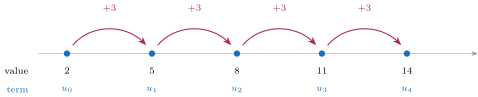
The figure shows the arithmetic sequence with first term and common difference : on a number line, we move forward by equal jumps.