Continuity
Course · Mathematics (Grade 11 Humanities, Lebanon), chapter 5 · Lebanon, Grade 11 Humanities · the beginning of the chapter, the rest on Adloun
During a day, the outdoor temperature goes from degrees in the morning to degrees in the afternoon. It does not “jump” from one value to another: it changes little by little, and its curve is drawn in a single stroke. The price of shipping a parcel behaves differently: it is dollars up to one kilogram, then suddenly becomes dollars as soon as the parcel weighs one gram more. Its curve is made of separate pieces.
The first situation is that of a continuous function, the second that of a discontinuous function. This chapter makes these two words precise using the notion of limit: first at a point, then on an interval. Finally, it states which usual functions are continuous, which saves us from checking it every time.
Curriculum: LB-1H
Required skills
- Recognize on a curve whether a function is continuous or discontinuous at a point.
- Study the continuity of a function at a point by comparing its limits at and the value .
- State on which intervals a function is continuous, from its curve or from its expression.
- Know the continuity of the usual functions: polynomials, rational functions, square root.
5.1 Continuity at a point
5.1.1 The idea: drawing without lifting the pencil
The two curves below represent two functions defined near a number . On each, the solid dot is the point of the curve with abscissa : its height is .
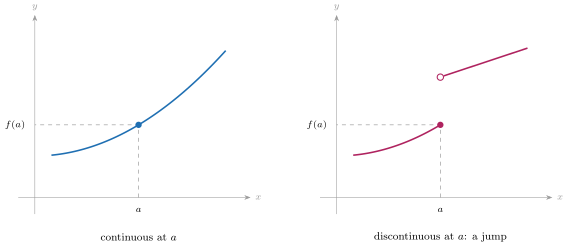
- On the left, we go through the point with abscissa without lifting the pencil. When approaches , from one side or the other, approaches .
- On the right, the curve makes a jump above : the pencil must be lifted. When approaches from the right, approaches the height of the small hollow circle, which is not .
A small hollow circle indicates a point that does not belong to the curve; a solid dot, a point that belongs to it.
5.1.2 Definition
The previous observation is expressed with a limit.
Let be a function defined at a number and around . We say that is continuous at if
Otherwise, we say that is discontinuous at .
This equality contains three requirements:
- exists: the function is defined at ;
- has a limit at : the left-hand limit and the right-hand limit are equal to the same number;
- this limit is equal to .
Let . We have , and we know that . So : the square function is continuous at .
The function is not defined at . We say neither that it is continuous at , nor that it is discontinuous at : at , the question makes no sense.
5.1.3 Studying continuity at a point
The interesting cases are those of piecewise-defined functions: one formula on one side of , another formula on the other side.
Method : Studying the continuity of at
- Calculate , with the formula valid at .
- Calculate the left-hand limit , with the formula valid for .
- Calculate the right-hand limit , with the formula valid for .
- Conclude: if the three numbers are equal, is continuous at ; otherwise, is discontinuous at .
Exercises of the chapter
- Reading continuity on a curve solved
- Two pieces that join up solved
- A jump solved
- The usual functions solved
- Continuous on the whole of ? solved
- Finding the right junction solved