Derivatives
Course · Mathematics (Grade 11 Humanities, Lebanon), chapter 6 · Lebanon, Grade 11 Humanities · the beginning of the chapter, the rest on Adloun
A coach travels from Beirut to Tripoli: about kilometers in hours. Its average speed is kilometers per hour. Yet perhaps at no moment did the speedometer show exactly : the coach drove faster on the highway, more slowly in traffic jams, and it stopped at the traffic lights. The average speed sums up the whole trip; the speedometer, on the other hand, shows the speed at a precise instant.
How do we go from one to the other? By calculating the average speed over a shorter and shorter duration around the chosen instant: one minute, one second, a tenth of a second… The limit of these average speeds is the speed at that instant. This passage to the limit is the idea of the derivative at a point. This chapter defines it, then gives calculation rules that save us from going back to the definition every time.
Curriculum: LB-1H
Required skills
- Calculate the rate of change of a function between two numbers and interpret it.
- Calculate a derivative at a point from the definition, in simple cases.
- Know the derivatives of the usual functions: constants, , , .
- Differentiate a sum, the product of a function by a number, a product and a quotient.
6.1 Definitions
6.1.1 Rate of change
A small town had inhabitants in and inhabitants in . In years, it gained inhabitants: on average, inhabitants per year. This quotient, “change in the population divided by the duration”, is called a rate of change.
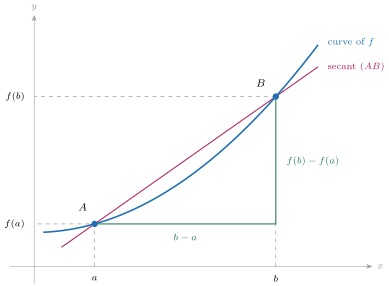
Let be a function, and and two distinct numbers of its domain of definition. The rate of change of between and is the number
The rate of change measures the average speed of variation of between and : by how much changes, on average, when increases by .
Let . Between and , the rate of change is
Between and , it equals . A negative rate of change means that has decreased between the two numbers.
A train starts. The distance it has covered after seconds is meters. Between the instants and , it covers meters in seconds. Its average speed over this duration is the rate of change of between and :
Graphical reading. On the curve of , let us place the points and . The line is called a secant to the curve. To go from to , we move forward by and up by : the rate of change is the slope of the secant .
6.1.2 Derivative at a point
Let us go back to the train: . What is its speed at the instant ? Let us calculate its average speed between the instant and a very close instant, , for shorter and shorter durations .
| duration (s) | ||||
|---|---|---|---|---|
| distance (m) | ||||
| average speed (m/s) |
The average speeds get closer to . The calculation explains it: for ,
and . At the instant , the speed of the train is meters per second. We say that is the derivative of at .
Let be a function defined at a number and around . We say that is differentiable at if the rate of change of between and has a finite limit as tends to . This limit is called the derivative of at ; it is denoted :
The notation is read “ prime of ”.
Method : Calculating with the definition
- Calculate .
- Calculate and expand.
- Form the rate of change and simplify it by canceling .
- Let tend to in the simplified expression.
Let . Let us calculate .
- .
- .
- .
- .
So is differentiable at and .
If we directly replace with in the rate of change, we get “”: this is an indeterminate form. Canceling is precisely the way to remove it.
Interpretations. The derivative is the speed of variation of at the instant : a speed on the speedometer if is a distance, a growth rate if is a population, a rate of increase if is a price.
On the curve, is the limit of the slopes of the secants as the point gets closer to the point with abscissa . The figure shows this for and : the three secants drawn have the slopes , and . These slopes get closer to , which measures the slope of the curve at the point .