Applications of differentiation
Course · Mathematics (Grade 11 Humanities, Lebanon), chapter 7 · Lebanon, Grade 11 Humanities · the beginning of the chapter, the rest on Adloun
A theater company is preparing its end-of-year show and must set the ticket price. If the ticket is very cheap, the hall fills up, but each spectator brings in little. If it is very expensive, each ticket brings in a lot, but the hall stays almost empty. In between, there is a price that brings in the largest revenue. How can we find it without trying all the prices one by one?
The derivative answers this question. The previous chapter taught how to calculate it; this one shows what it is used for. Its sign tells whether a function increases or decreases; its value at a number gives the slope of the tangent to the curve; and the numbers where it is zero and changes sign are those where the function reaches a peak or a trough.
Curriculum: LB-1H
Required skills
- Deduce the direction of variation of a function from the sign of its derivative.
- Draw up the table of variations of a function.
- Write the equation of the tangent to a curve at a point, and draw this tangent.
- Read a derivative on a graph.
- Find the local extrema of a function using its derivative.
7.1 Derivative and increase of a function
7.1.1 Increasing function, decreasing function
Let us recall the vocabulary. We consider a function defined on an interval .
- is increasing on if, when increases in , increases too: for all numbers of , we have .
- is decreasing on if, when increases in , decreases: for all numbers of , we have .
- is constant on if keeps the same value for all the of .
With strict inequalities, or , we say that is strictly increasing or strictly decreasing.
On a graph, we go along the curve from left to right: it rises where the function is increasing, it falls where the function is decreasing. Studying the variations of a function means finding the intervals where it is increasing and those where it is decreasing.
7.1.2 Observing: the sign of the derivative
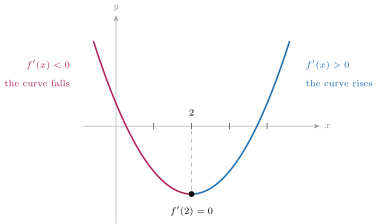
The derivative measures the speed of variation of . If it is positive, the value of is increasing; if it is negative, it is decreasing. Let us check this on the function , with derivative .
Before , the derivative is negative, and the values of decrease: , , , . After , the derivative is positive, and the values of increase: , , , . The curve confirms this observation.
7.1.3 The theorem
This observation is general; we accept it without proof.
Let be a function differentiable on an interval .
- If for every of , then is strictly increasing on .
- If for every of , then is strictly decreasing on .
- If for every of , then is constant on .
In one sentence: positive derivative, increasing function; negative derivative, decreasing function.
The first two conclusions remain true when is zero at an isolated number of the interval. In the previous example, is positive for and zero only at : the function is strictly increasing on , the number included.
- : for every real . The function is increasing on . We find a known result: an affine function with a positive slope is increasing.
- : . The function is decreasing on .
- : for every . The square root function is increasing on .
7.1.4 The table of variations
Most often, the derivative changes sign: the function is increasing on some intervals, decreasing on others. We then sum up the study in a table of variations, which has three rows: the values of , the sign of , then the variations of , shown by arrows.
Method : Drawing up a table of variations
- Calculate the derivative .
- Find the numbers where is zero.
- Study the sign of : sign of an expression , or sign of a trinomial.
- Fill in the table: an upward arrow () under each sign, a downward arrow () under each sign.
- Calculate the value of at each number where is zero, and write it at the end of the arrows.
For step 3, two reminders are almost always enough.
- Sign of (with ): the expression is zero at ; it has the sign of after this number, and the opposite sign before.
- Sign of a trinomial : it has the sign of , except between its roots when it has two.
Let us go back to .
- .
- when , that is, .
- The coefficient of is , positive: is negative before and positive after .
- The function is decreasing on and increasing on .
- .