The notion of probability
Course · Mathematics (Grade 11, Lebanon), chapter 18 · Lebanon, Grade 11 · the beginning of the chapter, the rest on Adloun
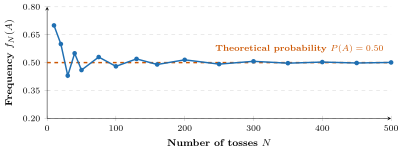
When the same random experiment is repeated a very large number of times under identical conditions — for example by tossing a coin or rolling a die a thousand times —, we observe that the frequency with which each outcome appears ends up stabilizing around a fixed numerical value between and . This experimental phenomenon of stabilization of frequencies leads to modeling chance mathematically by assigning to each event a real number called its probability.
This chapter first defines the general notion of a probability distribution on a finite sample space , then studies the fundamental case of equiprobability (in which calculating a probability reduces to a quotient of counts by Laplace's formula), before establishing the algebraic rules of calculation for the probabilities of a union, an intersection and a complementary event.
Curriculum: LB-1S · LB-1H
Required skills
- Check that a family of numbers defines a probability distribution on a finite sample space ( and ) and calculate the probability of an event as the sum of the probabilities of the outcomes that make it up.
- Recognize an equiprobable situation and apply Laplace's formula , in particular for successive draws with replacement (-lists) or without replacement (arrangements).
- Prove and use the fundamental relations: when , , and .
- Use passing to the complementary event to calculate the probability of an event involving the phrase “at least one”.
- Use a two-way table, a Venn diagram or a weighted tree to determine probabilities.
18.1 Probability
18.1.1 From observed frequency to theoretical probability
When the same random experiment with sample space is repeated times, independently and under identical conditions, we can count the number of times a given event occurred. The quotient
is the empirical frequency of occurrence of the event over this series of trials.
Observation shows that, when becomes very large, the frequency fluctuates less and less and tends to stabilize around a theoretical constant denoted , called the probability of the event . Now, whatever the size of the sample, statistical frequencies satisfy the following properties:
- for every event , ;
- for the certain event, , and for the impossible event, ;
- if and are two incompatible events (), then , hence .
The axiomatic definition of a probability on a finite sample space consists of keeping exactly these fundamental properties.
18.1.2 Probability distribution and probability of an event
Let be a finite sample space with outcomes (). Defining a probability distribution on means associating with each outcome a real number , called the probability of the elementary event and denoted , in such a way that:
- for every , we have ;
- the sum of the probabilities of all the elementary events is equal to :
A probability distribution on is usually summarized by a table:
| Outcome | Total | ||||
|---|---|---|---|---|---|
| Probability |
Let be a finite sample space equipped with a probability distribution .
- The probability of the impossible event is zero: .
- For every nonempty event , the probability of the event , denoted , is equal to the sum of the probabilities of the elementary events that make up :
The pair is then called a finite probability space.
For every event of a finite sample space equipped with a probability :
Exercises of the chapter
- Probability distribution in geometric progression and a loaded die solved
- Set relations, inclusion-exclusion formula and systems in and solved
- Workshop inspection and a three-criterion Venn diagram solved
- Successive draws with and without replacement from a numbered two-color urn solved
- Random placements in a row, the block method and alternation solved
- Weighted tree, urn with an integer parameter and distribution of a gain solved