Probability vocabulary
Course · Mathematics (Grade 11, Lebanon), chapter 17 · Lebanon, Grade 11 · the beginning of the chapter, the rest on Adloun
Rolling a fair die, picking at random an electronic component at the end of an assembly line, observing the blood group of a volunteer donor or successively drawing two cards from a deck: although these experiments obey the laws of physics or biology, too many factors escape the observer's control for the result to be predicted with certainty before the trial. We then speak of a random experiment.
Before we can assign a numerical value to the chance that a result occurs, it is essential to translate these situations rigorously into the language of set theory. This chapter establishes this fundamental dictionary: it defines the sample space , the outcomes , events as subsets of , as well as the logical and set operations (intersection, union, complement, incompatibility, De Morgan's laws and partition) that make it possible to build complex events from simple events.
Curriculum: LB-1S · LB-1H
Required skills
- Recognize a random experiment, describe the sample space and determine its cardinality in the finite case.
- Identify an event as a subset of , an elementary event , the certain event and the impossible event .
- Translate a statement in everyday language using operations on events: intersection (“ and ”), union (“ or ”), complementary event (“not ”) and difference (“ but not ”).
- Recognize two incompatible events () and not confuse incompatible events with complementary events.
- Use De Morgan's laws ( and ) and recognize a complete system of events (partition of ).
17.1 Random experiment
17.1.1 Random experiment, outcome and sample space
- A random experiment (or random trial) is an experiment that can be repeated under identical conditions, for which we can describe in advance the set of all possible results, but for which we cannot predict with certainty which particular result will occur before carrying it out.
- Each possible result of a random experiment is called an outcome (or a possible outcome); it is generally denoted .
- The set of all possible outcomes of the random experiment is called the sample space (or universe of possibilities) and is denoted .
Heating pure water at normal atmospheric pressure up to is not a random experiment: we know with certainty that the water will boil (a deterministic experiment). On the other hand, tossing a coin or drawing a ballot at random from an urn is a random experiment.
17.1.2 Finite sample space and cardinality according to the observation method
The same physical setup can lead to different sample spaces depending on what the observer chooses to record at the end of the experiment. When has a finite number of outcomes, counting tools make it possible to calculate its cardinality without having to write out all the outcomes when is large.
- Rolling a cubic die: the faces being numbered from to , if we record the number on the top face, the sample space is and . If we record only the parity of the number obtained, the sample space is and .
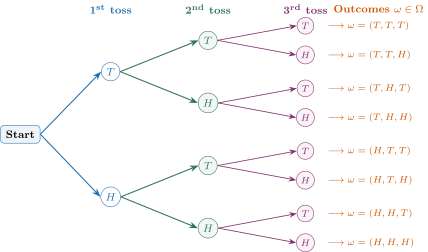
- Three successive tosses of a coin: writing for “Tails” and for “Heads”, each outcome is an ordered triple (-list of ). The cardinality of the sample space is , and the tree below explicitly lists the outcomes:
- Successive draws of balls from an urn containing balls numbered from to :
- If the draw takes place with replacement, each outcome is a -list of : .
- If the draw takes place without replacement, each outcome is an arrangement of distinct elements from : .
17.2 Events
17.2.1 Definition and occurrence of an event
When we carry out a random experiment, we are often interested in a property of the result obtained (for example: “getting an even number”, “drawing at least one red ball”, “the sum of the two dice is greater than or equal to ”). Such a property is characterized by the subset of the outcomes that satisfy it.
Let be the sample space associated with a random experiment.
- An event is any part (or any subset) of the sample space ().
- When we carry out the random experiment and obtain the outcome , we say that the event is realized (or occurs) if and only if belongs to ().
We roll a cubic die whose faces are numbered from to : .
- The event : “getting an even number” is the subset ().
- The event : “getting a number greater than or equal to ” is ().
- The event : “getting a divisor of ” is ().
If the roll of the die gives the face , then the events and are realized (because and ), whereas the event is not realized (because ).
17.2.2 Special events and inclusion
Let be the sample space of a random experiment.
- An elementary event is any event containing a single outcome of , that is any singleton ().
- The whole sample space is called the certain event: whatever the outcome of the trial, we always have , so the event is always realized.
- The empty set is called the impossible event: since it contains no outcome (), it is never realized.
Exercises of the chapter
- Influence of the observation protocol on the sample space and its cardinality solved
- Tree of outcomes and events in conditional throws solved
- Set-theoretic translation of three events and truth table solved
- Set identities, De Morgan's laws and incompatibility solved
- Partition of a sample space into eight regions by three events solved
- Complete systems of events in successive draws solved