Arrangements and permutations
Course · Mathematics (Grade 11, Lebanon), chapter 16 · Lebanon, Grade 11 · the beginning of the chapter, the rest on Adloun
How many four-digit secret codes can be entered on the keypad of a safe? In how many different ways can the first three places of a race with twelve athletes be awarded, or eight distinct books be arranged on a shelf? These questions belong to combinatorial analysis (or counting), whose purpose is to count the number of elements of a finite set without having to list them one by one.
This chapter introduces the fundamental counting principles when the order of the elements matters: the factorial notation , arrangements without repetition (the model of successive draws without replacement), the permutations of a finite set with elements, as well as -lists (or arrangements with repetition, the model of successive draws with replacement).
Curriculum: LB-1S · LB-1H
Required skills
- Use the addition principle (union of disjoint sets) and the multiplication principle (multi-stage choice tree) to count concrete situations.
- Handle the factorial notation , use the relation and simplify quotients of expressions involving factorials.
- Recognize an arrangement without repetition of elements from () and calculate their number .
- Count the permutations of a set with elements () as well as the anagrams of a word.
- Recognize a -list of a set with elements (successive draws with replacement) and calculate their number .
- Distinguish, in a counting problem where order matters, situations with repetition () from situations without repetition ().
16.1 Factorial
16.1.1 Finite set, cardinality and addition principle
A set is said to be finite if it is empty or if it contains a definite number of distinct elements (). This natural number is called the cardinality of the set and is denoted . By convention, the cardinality of the empty set is zero: .
Let and be two finite subsets of a set .
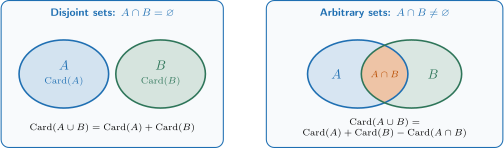
- If and are disjoint (that is, if ), then:
- More generally, if are pairwise disjoint finite subsets ( for all ), then:
- If and are any two finite subsets (not necessarily disjoint), then:
Proof
- When , no element belongs to both and . Listing the elements of therefore amounts to listing all the elements of , then all those of , without any duplicate, hence . The generalization to pairwise disjoint sets is obtained step by step.
- When and have a nonempty intersection, the sum counts twice each element belonging to (once in and once in ). We must therefore subtract once to get the exact number of elements of .
16.1.2 Multiplication principle and counting trees
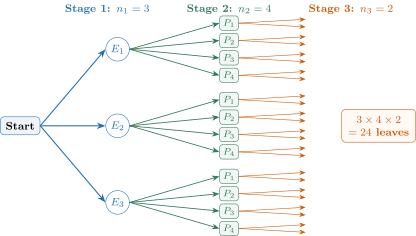
When an operation involves several successive choices, all the possibilities can be represented with a choice tree (or counting tree) in which each path from the root to a leaf corresponds to a complete outcome.
If a procedure takes place in successive stages such that:
- the first stage offers possibilities;
- for each of them, the second stage offers possibilities;
- for each choice in the previous stages, the -th stage offers possibilities,
then the total number of possible outcomes for the whole procedure is equal to the product:
A restaurant offers a menu made up of a starter chosen from (), a main course chosen from () and a dessert chosen from ().
- The choice of the starter offers possibilities.
- For each starter, the choice of the main course offers possibilities, that is pairs (starter, main course).
- For each pair (starter, main course), the choice of the dessert offers possibilities.
By the multiplication principle, the total number of distinct complete menus is:
16.1.3 Factorial notation
Let be a nonzero natural number (). The factorial of , denoted , is the product of all the natural numbers from to :
By convention, we set:
Exercises of the chapter
- Factorial simplifications, telescoping sums and equations in solved
- Addition principle, multiplication principle and routes in stages solved
- Four-digit numbers with parity and order constraints solved
- Successive draws of tokens and the complement method solved
- Permutations with grouped blocks and alternating categories solved
- Anagrams with repetitions and constraints on the ends solved