Scalar product and cross product
Course · Mathematics (Grade 11, Lebanon), chapter 15 · Lebanon, Grade 11 · the beginning of the chapter, the rest on Adloun
How can we measure the angle between two oblique beams of a roof frame, determine the equation of the plane of a roof section defined by three supports, calculate the area of a triangular facet in space or find the minimal distance from a point to a taut cable? Two fundamental operations on the vectors of space make it possible to solve these problems by calculation: the scalar product, which associates with two vectors a real number related to lengths and angles, and the cross product, specific to oriented three-dimensional space, which associates with two vectors a third vector perpendicular to the first two and whose norm measures the area of the parallelogram they generate.
Curriculum: LB-1S
Required skills
- Calculate the scalar product of two vectors of space using the cosine, an orthogonal projection, the polarization identities or the coordinates in an orthonormal coordinate system.
- Characterize the orthogonality of two vectors or of two lines of space by the vanishing of the scalar product.
- Calculate the norm of a vector, the distance between two points and the cosine of a geometric angle in an orthonormal coordinate system; use the Al-Kashi theorem and the median theorem in a triangle of space.
- Determine a normal vector and a Cartesian equation of a plane (in particular of the perpendicular bisector plane of a segment).
- Know the geometric definition, the properties and the analytic expression of the cross product in a right-handed orthonormal basis.
- Use the cross product to study the collinearity of two vectors or the collinearity of three points, determine a vector normal to the plane , calculate the area of a parallelogram or of a triangle and the distance from a point to a line.
15.1 Scalar product
15.1.1 Definition, trigonometric expression and orthogonal projection
Two vectors and of space always have representatives with the same initial point , written and . Since three points , , always lie in at least one plane , the scalar product in space is reduced to the scalar product in this plane .
Let and be two vectors of space, and let , , be three points such that and . The scalar product of and , denoted , is the scalar product of the vectors and calculated in any plane containing , and :
- if or , then ;
- if and , then:
In particular, the scalar square of is , and .
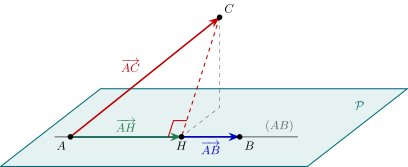
Let , , , be four points of space with .
- If is the orthogonal projection of onto the line , then:
- More generally, if and are the respective orthogonal projections of and onto the line , then .
15.1.2 Algebraic properties, polarization and orthogonality
For all vectors , , of space and every real number :
- Symmetry: .
- Bilinearity: and .
- Special identities and polarization identities:
Two vectors and of space are orthogonal, which is written , if and only if their scalar product is zero:
In particular, two lines and are orthogonal if and only if .
Let be a cube with edge .
- The orthogonal projection of onto the line is since the face is orthogonal to at . Consequently, .
- Decomposing by Chasles' relation, . The long diagonal and the face diagonal are therefore orthogonal.
15.2 Analytic expression
In an orthonormal basis of space, let and be two vectors. The scalar product of and is given by:
In particular, the vectors and are orthogonal if and only if:
Proof
We write and . By bilinearity of the scalar product, the expansion of has nine terms:
Since the basis is orthonormal, we have and . The six cross terms vanish and there remains .
In an orthonormal basis, the vectors and satisfy : they are therefore orthogonal.
Exercises of the chapter
- Scalar products and orthogonal lines in a cube solved
- Triangle in space, Al-Kashi formula and median theorem solved
- Normal vector, Cartesian equation of a plane and orthogonal projection solved
- Constructing a right-handed orthonormal basis and Lagrange's identity solved
- Area of a parallelogram, altitude of a triangle and distance to a line solved
- Vector equation in oriented space solved