Vectors and coordinate systems in space
Course · Mathematics (Grade 11, Lebanon), chapter 14 · Lebanon, Grade 11 · the beginning of the chapter, the rest on Adloun
To locate an aircraft in flight, describe the assembly of a steel frame or model a three-dimensional crystal, two coordinates are no longer enough: the -coordinate must be added to the -coordinate and the -coordinate. The vector calculus studied in the plane extends naturally to the whole of space while keeping the same operating rules. The essential novelty lies in the notion of coplanarity of three vectors, which makes it possible to characterize a plane with vectors, to prove that a line is parallel to a plane, and to decompose every vector of space uniquely in a basis of three non-coplanar vectors.
Curriculum: LB-1S
Required skills
- Extend to space the operations on vectors (equality, sum, Chasles' relation, parallelepiped rule, multiplication by a real number) and collinearity.
- Characterize a line and the midpoint of a segment with vectors; express collinearity of points or parallelism of two lines.
- Recognize and prove that three vectors are coplanar or non-coplanar; characterize a plane with vectors and prove that four points are coplanar.
- Prove that a line is parallel to a plane, or that two planes are parallel, using coplanarity of vectors.
- Decompose a vector in a basis of three non-coplanar vectors; determine the coordinates of a vector and of a point in a coordinate system of space.
- Use the analytic expressions of vector operations, of the midpoint of a segment, of the centroid of a triangle or of a tetrahedron, of collinearity and of coplanarity.
- Recognize an orthogonal or orthonormal basis or coordinate system, and determine the orientation of a trihedron or of a right-handed orthonormal basis.
14.1 The vector in space
14.1.1 Definition and equality of vectors
The notion of vector studied in plane geometry extends unchanged to space. Indeed, any two points always lie on the same line and any three points always lie in the same plane.
- With every pair of points of space we associate the vector . When , the vector is characterized by:
- its direction: that of the line ;
- its sense: the sense of travel from to on the line ;
- its norm (or length): the distance , denoted .
- When and coincide, is the zero vector, denoted , with zero norm and no defined direction or sense.
- Two vectors and are equal, and we write , if and only if the quadrilateral is a parallelogram (possibly degenerate), that is if and only if the segments and have the same midpoint.
For every point of space and every vector , there exists a unique point of space such that . The point is the image of under the translation by vector .
14.1.2 Sum of vectors and parallelepiped rule
Let and be two vectors of space. If we choose three points , , such that and , the sum is the vector . We thus get, for all points , , of space:
If and , then , where is the parallelogram constructed on and (parallelogram rule).
Addition of vectors of space is commutative () and associative (), has as identity element, and every vector has an opposite such that .
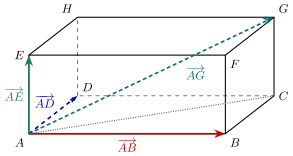
Let be a parallelepiped (a solid with six parallelogram faces whose opposite faces are parallel and congruent). Then:
Proof
The face is a parallelogram, so the parallelogram rule gives . Moreover, the edges and are parallel, with the same sense and the same length (since ), hence . Applying Chasles' relation to the points , and , we get:
14.1.3 Multiplication by a real number, collinearity, line and midpoint
- Let be a nonzero vector and a nonzero real number. The vector is the vector with the same direction as , with norm , with the same sense as if and the opposite sense if . Moreover, and .
- Two vectors and of space are collinear if there exists a real number such that or . The zero vector is collinear with every vector.
For all vectors , and all real numbers , , we have , , , and:
- Let be a point of space and a nonzero vector. The set of points of space for which there exists a real number satisfying is the line passing through with direction vector , denoted .
- Three points , , are collinear if and only if the vectors and are collinear.
- Two lines with direction vectors and are parallel if and only if and are collinear.
- A point is the midpoint of the segment if and only if , which is equivalent to , or, for every point of space, to:
Let be a parallelepiped, the center of the upper face (midpoint of ) and the point defined by . Decomposing by Chasles' relation:
since . We deduce : the vectors and are collinear, so the points , , are collinear and is the midpoint of the segment .
14.2 Coplanar vectors
14.2.1 Definition and characterization by linear combination
Any two vectors of space always have representatives with the same initial point lying in the same plane. The question of belonging to the same plane therefore arises from three vectors onward.
Three vectors , and of space are said to be coplanar if, choosing any point and the points , , such that , and , the four points , , , lie in the same plane. Otherwise, the vectors , , are said to be non-coplanar.