Orthogonality in space
Course · Mathematics (Grade 11, Lebanon), chapter 13 · Lebanon, Grade 11 · the beginning of the chapter, the rest on Adloun
On a construction site, checking that a pillar erected on a horizontal slab is vertical does not require checking the right angle with every line drawn on the slab: two set squares placed at the foot of the pillar in two intersecting directions are enough. Likewise, the common edge of two intersecting vertical partitions is automatically perpendicular to the floor, and the set of points of space located at the same distance from two transmitters forms a plane perpendicular to the segment joining them at its midpoint. All these properties rest on the theorems of orthogonality in space.
This chapter defines the orthogonality of two lines in space — which does not require them to be coplanar —, then the perpendicularity of a line and a plane and its fundamental criterion using two intersecting lines. It establishes the relations between parallelism and orthogonality, the orthogonal projection onto a plane, the distance from a point to a plane and the theorem of the three perpendiculars. It then studies perpendicular planes, then the perpendicular bisector plane of a segment and its applications to the axis of a circle and to the sphere circumscribed about a tetrahedron.
Curriculum: LB-1S
Required skills
- Distinguish perpendicular lines (intersecting) from orthogonal lines (coplanar or not) in space; study the orthogonality of two lines on common solids (cube, rectangular prism, prism, pyramid, tetrahedron).
- Prove that a line is perpendicular to a plane by proving that it is orthogonal to two intersecting lines of this plane; deduce that two lines of space are orthogonal.
- Use the theorems relating parallelism and orthogonality of lines and planes, the orthogonal projection onto a plane, the distance from a point to a plane and the theorem of the three perpendiculars.
- Recognize and prove that two planes are perpendicular; use the properties of the line of intersection of two planes perpendicular to the same third plane.
- Characterize the perpendicular bisector plane of a segment as the set of points equidistant from its endpoints; determine the axis of a circle in space and the center of the sphere circumscribed about a tetrahedron.
In the figures, drawn in oblique (cavalier) projection, hidden lines are drawn as dashed lines and right angles — possibly distorted by the projection — are marked by a small parallelogram.
13.1 Orthogonal lines
Let and be two lines of space.
- We say that and are orthogonal, and we write , if, through any point of space, the parallels and drawn to and to respectively are perpendicular in the plane they determine.
- We say that and are perpendicular if they are both orthogonal and intersecting (hence coplanar).
This definition does not depend on the chosen point : if we replace by another point , the new parallels to and are parallel to and respectively, hence still perpendicular. In space, two perpendicular lines are always orthogonal, but two orthogonal lines are not necessarily intersecting: they may be non-coplanar (skew lines). When they are coplanar, saying that they are orthogonal amounts to saying that they are perpendicular.
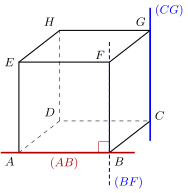
- In the cube above, the lines and are not coplanar. The parallel to passing through is , which is perpendicular to at (since is a square). The lines and are therefore orthogonal without being perpendicular. Likewise, the face diagonal and the edge are orthogonal since and .
- In a regular tetrahedron (whose six edges have the same length), two opposite edges such as and are not coplanar, but we will prove in the next section that they are orthogonal.
- If two lines and are parallel, every line orthogonal to one of them is orthogonal to the other:
- If two lines are orthogonal to the same third line, they are not necessarily parallel to each other.
Proof
- Since , the parallel to drawn through a point coincides with the parallel to drawn through ; it is therefore perpendicular to the parallel to drawn through , hence .
- In the cube , the lines and are both perpendicular to at , but they intersect (they are even perpendicular) and are not parallel.
13.2 Line perpendicular to a plane
13.2.1 Definition and fundamental theorem
A line is said to be perpendicular (or orthogonal) to a plane , and we write , if it is orthogonal to all the lines contained in .
A line perpendicular to a plane necessarily cuts this plane at a point (if it were parallel to , it would be parallel to a line of , to which it could not be orthogonal). The following fundamental theorem avoids having to check orthogonality with all the lines of the plane.
A line is perpendicular to a plane if and only if it is orthogonal to two intersecting lines of this plane.
Proof
The forward implication follows immediately from the definition. Conversely, suppose that is orthogonal to two intersecting lines and of , which intersect at a point , and let us show that is orthogonal to every line of . Replacing and if necessary by their parallels passing through (which preserves orthogonality by the previous section and keeps the parallel to in ), we may assume that and pass through , with distinct from and .
- Draw in a line not passing through and cutting , , at , , respectively.
- Choose on two points and symmetric with respect to ( is the midpoint of , with ).
- Since and , the lines and are the perpendicular bisectors of in the planes and : we therefore have and .
- The triangles and have their three sides respectively equal ( common, , ): they are congruent. For every point of the line , we deduce .
- The triangle is therefore isosceles at ; its median from is also an altitude, so at . Thus is orthogonal to every line of , that is .
Exercises of the chapter
- Right prism with a right-triangle base and the theorem of the three perpendiculars solved
- Cube, midpoint line and perpendicular planes solved
- Perpendicular bisector planes, axis of an equilateral triangle and sphere circumscribed about the regular tetrahedron solved
- Orthogonal projection of a vertex in a trirectangular tetrahedron and volume calculated in two ways solved
- Dihedral angle between the base and the lateral faces of a regular pyramid solved
- Common perpendicular and shortest distance between two non-coplanar lines of a cube solved