Equation of a circle
Course · Mathematics (Grade 11, Lebanon), chapter 12 · Lebanon, Grade 11 · the beginning of the chapter, the rest on Adloun
A maritime beacon emits a radio signal received within a radius of twelve kilometers; a ship follows a straight heading given by its equation in a coastal coordinate system: when does it enter the covered zone, over what distance does it cross it, and at what angle does a lighthouse on the coast see the path at the closest point? All these questions amount to translating geometric properties of the circle and the disk into calculations in an orthonormal coordinate system.
This chapter first establishes the Cartesian equation of a circle defined by its center and its radius or by a diameter, studies the expanded form and gives the parametric representation of a circle. It then characterizes the disk and the regions of the plane bounded by circles and lines, introduces the power of a point with respect to a circle and the radical axis of two circles, then studies the relative position of a line and a circle as well as how to determine the tangents at a point of the circle, parallel to a given direction or drawn from an exterior point.
Curriculum: LB-1S
Required skills
- Write the Cartesian equation of a circle knowing its center and its radius, or the endpoints of a diameter; recognize the set of points satisfying and determine, when it is a circle, its center and its radius.
- Give a parametric representation of a circle and go from a parametric representation to a Cartesian equation.
- Characterize analytically the interior and the exterior of a circle; represent graphically regions of the plane defined by inequalities involving circles and lines.
- Calculate the power of a point with respect to a circle; use the invariance of the scalar product along a secant, the length of a tangent drawn from an exterior point and the equation of the radical axis of two circles.
- Study the relative position of a line and a circle by comparing the distance from the center to the line with the radius, or by solving algebraically; calculate the length of a chord.
- Determine an equation of the tangent at a point of a circle, of the tangents parallel to a given line and of the tangents drawn from an exterior point.
Throughout the chapter, the plane is referred to an orthonormal coordinate system .
12.1 Equation of a circle
12.1.1 Circle defined by its center and its radius
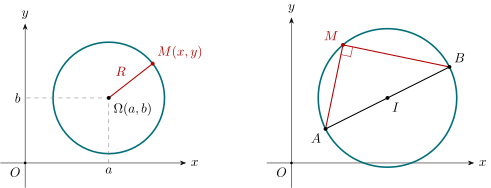
Let be a point of the plane and a positive real number. The circle with center and radius is the set of points of the plane whose coordinates satisfy the equation:
This equation is called the canonical Cartesian equation of the circle .
Proof
By definition, a point lies on the circle if and only if . Since both sides are nonnegative, this equality is equivalent to . Now, in the orthonormal coordinate system , the vector has coordinates , so that . We therefore do have .
The circle with center and radius has canonical equation . In particular, the circle centered at the origin with radius has equation .
12.1.2 Circle defined by a diameter
Let and be two distinct points of the plane and the midpoint of the segment . For every point of the plane, we have:
The circle with diameter is the set of points of the plane such that . Its Cartesian equation is:
Proof
Using Chasles' relation and the midpoint of , which satisfies , we write:
Thus, is equivalent to , which characterizes the circle with center and radius , that is the circle with diameter .
In the orthonormal coordinate system , the vectors and have the respective coordinates and . Their scalar product is:
hence the stated equation.
Let and . The circle with diameter has equation , that is . In canonical form, : we recover the midpoint of and the radius .
12.1.3 Expanded form and recognizing a circle
Expanding the canonical equation , we get:
Conversely, an equation of the form does not necessarily represent a circle.
Let , and be three real numbers, and let be the set of points of the plane such that:
Let and .
- If , then is the circle with center and radius .
- If , then is reduced to the single point .
- If , then is the empty set .
Proof
Putting the trinomials and in canonical form, we get:
The equation is therefore equivalent to:
that is . If , this is equivalent to (circle with center and radius ); if , to , that is ; if , no point works since the square of a distance is always nonnegative.
- For : , that is . This is the circle with center and radius .
- For : . The set is reduced to the point .
- For : dividing first by , we have , that is . The set is empty.
Exercises of the chapter
- Cartesian equation of a circle defined by its center, its diameter or three points solved
- Family of circles depending on a parameter and locus of the centers solved
- Tangent at a point, tangents with a given direction and tangents drawn from an exterior point solved
- Circle tangent to a line, chord cut off and parametric representation solved
- Relative positions of two circles, radical axis and tangents of equal length solved
- Dividing the plane into regions with circles and lines, areas of domains solved