Trigonometric formulas
Course · Mathematics (Grade 11, Lebanon), chapter 11 · Lebanon, Grade 11 · the beginning of the chapter, the rest on Adloun
In acoustics as in electricity or in wave mechanics, the superposition of two sinusoidal signals with the same frequency produces a single wave whose amplitude and phase shift depend on the two initial signals; the superposition of two waves with close frequencies brings out a beat phenomenon, in which a fast oscillation is modulated by a slow envelope. Mathematically, these phenomena all rest on the same family of identities: the trigonometric formulas.
This chapter first establishes the addition formulas from the scalar product on the trigonometric circle, as well as the reduction of to the form and its application to the equation . It then develops the double-angle and power-reduction formulas, the addition and double-angle formulas for the tangent, the linearization formulas (transforming a product into a sum) and the factorization formulas (transforming a sum into a product), then the rational half-angle formulas in terms of .
Curriculum: LB-1S
Required skills
- Establish and use the addition formulas for and ; calculate the trigonometric lines of angles such as and .
- Transform the expression into the form and solve the equation .
- Use the double-angle formulas (, ) and the power-reduction formulas (, ); calculate the trigonometric lines of .
- Apply the formulas for , and , stating their conditions of existence.
- Transform a product of cosines and sines into a sum (linearization) and a sum or difference into a product (factorization); deduce the solution of trigonometric equations.
- Express , and in terms of and use this change of unknown to solve trigonometric equations.
Throughout this chapter, the plane is equipped with a direct orthonormal coordinate system .
11.1 Addition formulas
11.1.1 Cosine and sine of and of
For all real numbers and , we have:
Proof
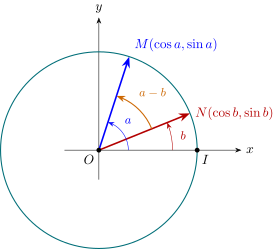
1. Geometric proof of . On the trigonometric circle , consider the image points and of the real numbers and . In the direct orthonormal coordinate system , the unit vectors and have the respective coordinates:
By Chasles' relation for oriented angles:
Let us express the scalar product in two ways:
- by the analytic expression in the orthonormal coordinate system: ;
- by the geometric definition: .
Equating the two expressions gives .
2. Deducing the other three formulas.
- Replacing by in the first formula and using the evenness of the cosine () and the oddness of the sine (), we get:
- Using the complementary-angle formula with :
- Finally, replacing by in the formula for , we get:
- Note that . By the addition formulas:
- Since (or more simply , the complementary angle of ), we deduce:
11.1.2 Transforming and the equation
Let and be two real numbers that are not both zero, and . There exists a real number (unique modulo ) such that:
Then, for every real number , we have:
Proof
Since , we have , and the real numbers and satisfy:
The point with coordinates therefore lies on the trigonometric circle: there exists a real number such that and (in other words, is a pair of polar coordinates of the point ). Factoring out , the addition formula gives:
Exercises of the chapter
- Trigonometric lines of and by addition and duplication solved
- Transforming into and solving equations solved
- Tangent formulas: sums of angles and equations solved
- Power reduction and linearization of products solved
- Transforming sums into products and factoring equations solved
- Half-angle formulas and rational equations solved