Elementary trigonometric equations
Course · Mathematics (Grade 11, Lebanon), chapter 10 · Lebanon, Grade 11 · the beginning of the chapter, the rest on Adloun
In the port of Beirut or of Tyre, the swell and the tides follow a periodic rhythm; the shadow of a cedar lengthens and shortens each day with the height of the sun above the horizon. These cyclic phenomena are modeled by the cosine, sine and tangent functions. Determining the precise moment when a periodic quantity reaches a given value, or the length of time during which it exceeds a threshold, leads directly to solving trigonometric equations and inequalities.
This chapter begins with the study of the oriented angles of two nonzero vectors in the oriented plane — principal measure, Chasles' relation and algebraic properties — as well as locating points in polar coordinates. It then establishes the complete solution of the fundamental equations , , and using the trigonometric circle, before dealing with elementary trigonometric equations in the general case, quadratic equations in , or , and trigonometric inequalities.
Curriculum: LB-1S
Required skills
- Determine the principal measure of an oriented angle of two vectors; use Chasles' relation and the properties of to calculate measures of oriented angles.
- Characterize the collinearity and the orthogonality of two nonzero vectors using oriented angles; prove that three points are collinear.
- Convert from the polar coordinates of a point other than the origin to its Cartesian coordinates , and conversely.
- Solve in and in a given interval the elementary equations , , and , and place the image points of the solutions on the trigonometric circle.
- Solve equations of the type , , , as well as using associated angles.
- Solve trigonometric equations that reduce to quadratic equations and simple trigonometric inequalities on the trigonometric circle.
Throughout this chapter, the plane is equipped with a direct orthonormal coordinate system ; angles are measured in radians.
10.1 Oriented angle of two vectors
10.1.1 Oriented plane and principal measure
The trigonometric circle is the circle with center and radius , oriented in the positive direction (or direct sense, counterclockwise), opposite to the direction of rotation of the hands of a clock. The opposite direction is the negative direction (or indirect sense, clockwise).
By wrapping the real line around the circle starting from the point — positive real numbers in the positive direction, negative real numbers in the negative direction —, we associate with every real number a unique point of , called the image point of . Two real numbers and have the same image point if and only if they differ by an integer multiple of , that is, if there exists such that , which we write .
Let and be two nonzero vectors of the oriented plane. The unit vectors and , drawn from the origin , have their respective endpoints and on the trigonometric circle .
The ordered pair of two nonzero vectors is called the oriented angle of the vectors and . If and are the points of the trigonometric circle such that and , the real number is a measure in radians of the oriented angle .
If is a measure of , all the measures of this oriented angle are the real numbers of the form with . By abuse of notation, we write:
Among all the measures of , there is one and only one that belongs to the half-open interval : it is called the principal measure of the oriented angle .
Method : Determining the principal measure of an angle
To find the principal measure of an angle of which a measure (, ) is known:
- We bound in , which is equivalent to , that is .
- Equivalently and more quickly, we divide by to the nearest integer to write with , which gives .
- For : the multiple of closest to is . Thus . Since , the principal measure is .
- For : the multiple of closest to is . Thus . The principal measure is .
- For : the principal measure is (since , whereas ).
10.1.2 Chasles' relation and algebraic properties
Let , and be three nonzero vectors of the oriented plane.
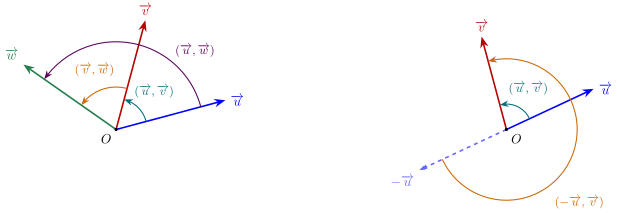
- Chasles' relation: .
- Zero angle and opposite angle: and .
- Opposite vectors:
- Multiplication by nonzero scalars: for all nonzero real numbers and ,
Proof
Let , and be the points of the trigonometric circle associated with the unit vectors of , and .
- A measure of is and a measure of is . Their sum is a measure of , hence Chasles' relation modulo .
- For , gives . Applying Chasles' relation with , we obtain , that is .
- The unit vector of is where is diametrically opposite to on , so . Thus, . By Chasles' relation:
Similarly, , and .
- If , the vector is collinear with and has the same direction, so its unit vector is the same as that of : . If , has the same unit vector as , so . Decomposing , we add if and , if and , and when and have opposite signs.
10.1.3 Collinearity and orthogonality
Let and be two nonzero vectors of the oriented plane.
- and are collinear with the same direction if and only if .
- and are collinear with opposite directions if and only if .
- and are collinear if and only if , that is, if there exists such that . In particular, three pairwise distinct points , and are collinear if and only if .
- and are orthogonal if and only if or , which can be written concisely as .
For every triangle , the sum of the oriented angles satisfies:
Exercises of the chapter
- Principal measures, Chasles' relation and properties of oriented angles solved
- Locating points in polar coordinates and geometric configurations solved
- Fundamental equations in cosine, sine, tangent and cotangent solved
- General equations , and equations on an interval solved
- Trigonometric equations reducing to quadratic equations solved
- Trigonometric inequalities on the circle and sign of a product solved