Numerical sequences
Course · Mathematics (Grade 11, Lebanon), chapter 9 · Lebanon, Grade 11 · the beginning of the chapter, the rest on Adloun
Whether we are tracking the capital deposited each year in a savings account, the size of a population counted at regular intervals or the monthly repayments of a loan, many phenomena do not vary continuously but step by step, at instants numbered by natural numbers . Such an ordered list of real numbers indexed by natural numbers is called a numerical sequence.
This chapter introduces numerical sequences, their notations and their two main modes of generation — by an explicit formula or by a recurrence relation — as well as their graphical representations (scatter plot, and staircase or cobweb construction using the first bisector ). It then presents, for the Sciences series, the fundamental principle of proof by induction, then sets out the methods for studying the direction of variation of a sequence and the complete study of arithmetic sequences, geometric sequences and arithmetic-geometric sequences.
Curriculum: LB-1S · LB-1H
Required skills
- Know the definition and the notations of a numerical sequence ; calculate the terms of a sequence defined by an explicit formula or by a recurrence relation.
- Represent a sequence graphically by a scatter plot or, for a recursive sequence , on the -axis using and the line .
- Write a proof by induction: base case, inductive step, conclusion (Sciences series).
- Study the direction of variation of a sequence (sign of , comparison of with for a sequence with strictly positive terms, direction of variation of when ) and recognize a sequence that is bounded above, bounded below or bounded.
- Recognize an arithmetic or geometric sequence, express its general term in terms of , determine its direction of variation and calculate a sum of consecutive terms.
- Study an arithmetic-geometric sequence using an auxiliary geometric sequence .
9.1 Numerical sequences
A numerical sequence is a function defined on the set of natural numbers (or on the set of natural numbers greater than or equal to a fixed integer ) with values in :
- The real number is called the term of index (or term of rank , or general term) of the sequence.
- The sequence as a whole is denoted , or simply .
- The term is the first term of the sequence (most often or ).
9.2 Notations
- The notation (with parentheses) denotes the whole sequence, that is, the function, while (without parentheses) denotes a real number, the value of the sequence at index .
- The expression denotes the term of index (which immediately follows ), while denotes the real number to which is added.
- When the sequence starts at index , the term is the -th term of the sequence (since from to inclusive, there are integers).
9.3 Defining a sequence
9.3.1 Definition by an explicit formula
A sequence is defined by an explicit formula when its general term is expressed directly in terms of the index , in the form , where is a function defined on (or on ). This formula makes it possible to calculate any term directly, without having to calculate the preceding terms.
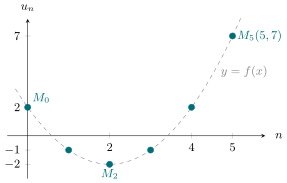
Let be the sequence defined for every natural number by . We have with . We immediately calculate:
In an orthogonal coordinate system , the graphical representation of the sequence is the scatter plot of isolated points lying on the parabola with equation .
9.3.2 Definition by a recurrence relation
A sequence is defined by a recurrence relation when we are given:
- its first term ;
- a relation for passing from one term to the next, of the form valid for every , where is a function called the function associated with the sequence.
To calculate a term of index , we must then calculate step by step all the terms that precede it: , then , , etc.
Method : Staircase or cobweb graphical construction
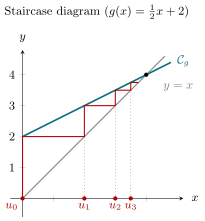
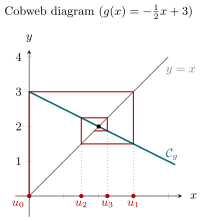
To represent on the -axis the first terms of a recursive sequence without calculating them numerically, we draw in an orthonormal coordinate system the curve with equation and the first bisector with equation :
- We place on the -axis and go vertically to the curve at the point , whose ordinate is .
- From , we go horizontally to the line () at the point : this horizontal move carries the ordinate over to the abscissa on .
- From , we go vertically to at the point , then horizontally to at the point , and so on.
When is increasing, the broken line forms a staircase diagram; when is decreasing, it winds into a cobweb (or spiral) around the point of intersection of and .
Exercises of the chapter
- Modes of generation of a sequence and graphical construction on the first bisector solved
- The three methods for studying monotonicity and bounding a sequence solved
- Proofs by induction: finite sum, inequality and recursive sequence solved
- Determining an arithmetic sequence, arithmetic mean and sum of terms solved
- Geometric progression, geometric mean and sums of powers solved
- Arithmetic-geometric sequence and homographic sequence solved