Antiderivatives
Course · Mathematics (Grade 11, Lebanon), chapter 8 · Lebanon, Grade 11 · the beginning of the chapter, the rest on Adloun
A vehicle travels along a straight road: we know its speed at every instant and we want to find the distance it has covered. A tank fills or empties at a known flow rate: we wish to determine the volume of water it contains at every instant. In both situations, we know the derivative of a function and we seek to work back to the function itself: this is the inverse operation of differentiation. A differentiable function whose derivative equals a given function is called an antiderivative (or primitive) of .
This chapter defines the notion of an antiderivative on an interval, proves that two antiderivatives of the same function on an interval differ by a real constant, then establishes the linearity rules and the tables of antiderivatives of the usual functions, of the composite forms , , and, for the Sciences series, of the trigonometric functions. Finally, it states the existence theorem for antiderivatives of a function continuous on an interval and shows that an initial condition determines a unique antiderivative, with its geometric and kinematic applications.
Curriculum: LB-1S · LB-1H
Required skills
- Know the definition of an antiderivative of a function on an interval and check by differentiation that a function is an antiderivative of a function .
- Know that if is an antiderivative of on an interval , the set of antiderivatives of on consists of the functions ().
- Use linearity and the table of antiderivatives of the usual functions (, for , ) as well as the composite forms , and .
- Determine the antiderivatives of the trigonometric functions , , , , , and linearize and (Sciences series).
- Determine the direction of variation of an antiderivative from the sign of .
- Determine the unique antiderivative of a continuous function on an interval satisfying a given condition , and apply it to kinematics.
Throughout this chapter, denotes an interval of , and the plane is equipped with an orthogonal coordinate system .
8.1 Set of antiderivatives of a function
8.1.1 Definition of an antiderivative on an interval
Let be a function defined on an interval of . An antiderivative of on the interval is any function differentiable on such that, for every :
- The function is an antiderivative of on , since is differentiable on and for every . The function is another one, since .
- The function is an antiderivative of on (as well as on ), since .
- The function is an antiderivative of on .
Method : Checking that a given function is an antiderivative of
To prove that a function given in a problem is an antiderivative of a function on an interval :
- We justify that is differentiable on the interval .
- We calculate the derivative using the rules of differentiation and check that for every .
Checking an antiderivative therefore always consists in differentiating the proposed function.
8.1.2 Set of all antiderivatives on an interval
Let be a function defined on an interval of . If has a particular antiderivative on , then:
- for every real constant , the function is an antiderivative of on ;
- conversely, every antiderivative of on is of the form , where is a real constant.
In other words, two antiderivatives of the same function on the same interval differ by a constant.
Proof
- Let and set for every . The function , the sum of the differentiable function and the constant function , is differentiable on and, for every , . So is an antiderivative of on .
- Conversely, let be any antiderivative of on . Then is differentiable on and for every . Consider the difference function : it is differentiable on the interval and, for every :
Now a differentiable function whose derivative is zero on an interval is constant on . There therefore exists a real number such that, for every , , that is .
8.1.3 Geometric interpretation: family of integral curves
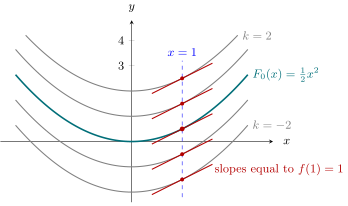
Let be an antiderivative of on an interval . For each real number , we denote by the representative curve of the antiderivative (these curves are sometimes called the integral curves of ).
- The curve is obtained from the curve of by the vertical translation by the vector .
- At all the points with the same abscissa , the tangents to the different curves have the same slope : these tangents are therefore all parallel to one another.
Uniqueness up to a constant holds only on an interval. On , which is the union of two disjoint intervals, the function has as antiderivatives the functions defined by on and on , where and are two independent constants.
8.2 Operations on antiderivatives
Let and be two functions having antiderivatives and respectively on an interval , and let and be two real numbers.
- The function is an antiderivative of the function on .
- The function is an antiderivative of the function on .
- More generally, the linear combination is an antiderivative of on .
Proof
Since the functions and are differentiable on , the linear combination is differentiable on . By the linearity of differentiation, for every :
The function is therefore indeed an antiderivative of on .
Exercises of the chapter
- Checking antiderivatives, additive constant and initial condition solved
- Antiderivatives of polynomials, sums of powers and decomposed fractions solved
- Recognizing the composite forms , , and solved
- Finding an antiderivative by identifying coefficients solved
- Trigonometric antiderivatives, linearization and odd powers solved
- Direction of variation, extrema and bounds for a non-explicit antiderivative solved