Sign of a second-degree trinomial
Course · Mathematics (Grade 11, Lebanon), chapter 2 · Lebanon, Grade 11 · the beginning of the chapter, the rest on Adloun
Determining over which time interval a projectile exceeds a given altitude, finding the dimensions of a rectangular enclosure whose area exceeds a fixed threshold, or specifying the set of real numbers for which a function involving a square root is defined: all these problems lead to studying the sign of a second-degree expression as the variable ranges over .
This chapter first recalls the canonical form of a second-degree trinomial and its interpretation in terms of an extremum, then proves the fundamental theorem giving the sign of according to the sign of the discriminant . These results make it possible to solve all second-degree inequalities, the product or quotient inequalities that reduce to them, as well as systems of second-degree inequalities in one unknown.
Curriculum: LB-1S · LB-1H
Required skills
- Write a second-degree trinomial () in canonical form and deduce its extremum on .
- Draw up the sign table of on according to the sign of its discriminant and that of the leading coefficient .
- Interpret graphically the sign of a trinomial by the position of the parabola with equation relative to the -axis.
- Solve in a second-degree inequality, a product inequality or a quotient inequality involving factors of the first and second degree.
- Solve a system of second-degree inequalities in one unknown and apply it to determining the domain of definition of a function.
2.1 Canonical form of a second-degree trinomial
2.1.1 Canonical form and extremum on
Let , and be three real numbers with , and let be the discriminant of the trinomial . For every real number , the expression:
is called the canonical form of the trinomial .
For every real number , the square is nonnegative and is zero only for . The canonical form therefore immediately gives the extremum of the function on .
Let (), with and .
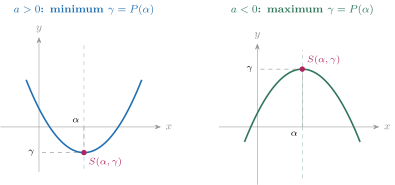
- If : for every , we have , so . The trinomial has on an absolute minimum equal to , reached at the unique value .
- If : for every , we have , so . The trinomial has on an absolute maximum equal to , reached at the unique value .
In an orthogonal coordinate system, the point is the vertex of the parabola with equation .
2.1.2 Reminder on the factorization of the trinomial
According to the sign of , the canonical form leads to the following expressions for every :
- if , the real number is strictly positive and cannot be factored in ;
- if , has the double root and can be written ;
- if , has two distinct real roots and factors as:
2.2 Sign of a second-degree trinomial
2.2.1 Fundamental theorem on the sign of
Let be a second-degree trinomial () with discriminant .
- First case: (no real root). For every , the trinomial is nonzero and always has the sign of :
- Second case: (a double root ). The trinomial is zero at and strictly has the sign of for every :
- Third case: (two distinct roots ). The trinomial is zero at and at ; it has the sign of outside the roots (on ) and the opposite sign (sign of ) between the roots (on ):
Exercises of the chapter
- Canonical form, extremum and the rule for the sign of the trinomial solved
- Relative position of two parabolas in a coordinate system solved
- Product inequality of trinomials and biquadratic inequality solved
- Quotient inequalities that reduce to the second degree solved
- Second-degree double inequality and system of inequalities solved
- Domains of definition and irrational inequality solved