Complex numbers
Course · Mathematics (Grade 11, Lebanon), chapter 3 · Lebanon, Grade 11 · the beginning of the chapter, the rest on Adloun
In the set of real numbers, the square of every number is nonnegative: algebraic equations as simple as or (whose discriminant is strictly negative) therefore have no real solution. In the 16th century, while trying to express by radicals the solutions of equations of degree , the Italian algebraists Gerolamo Cardano and Rafael Bombelli introduced a new number, written today as , satisfying .
This chapter constructs the set of complex numbers in their algebraic form (), defines the arithmetic operations (addition, multiplication, conjugation, inverse and quotient), solves second-degree equations in and associates with each complex number a point or a vector of the plane equipped with a direct orthonormal coordinate system.
Curriculum: LB-1S
Required skills
- Determine the algebraic form of a complex number, identify its real part and its imaginary part , and use the condition for two complex numbers to be equal.
- Calculate sums, products, integer powers of , inverses and quotients of complex numbers by multiplying by the conjugate of the denominator.
- Use the properties of the conjugate to characterize real numbers () and pure imaginaries () and solve equations involving and .
- Solve in any second-degree equation with real coefficients, determine the square roots of a complex number in algebraic form and solve a second-degree equation with complex coefficients.
- Represent a complex number in the complex plane, calculate the affixes of vectors, midpoints and centroids, and determine sets of points in the complex plane.
3.1 Definitions – operations on complex numbers
3.1.1 The set , algebraic form, real part and imaginary part
There exists a set of numbers, denoted and called the set of complex numbers, which contains the set of real numbers and satisfies the following three fundamental properties:
- contains a non-real element denoted (called the imaginary unit) such that:
- Addition and multiplication in extend those of and obey the same rules of calculation (commutativity, associativity, distributivity of multiplication over addition, special products).
- Every complex number can be written uniquely in the form:
Let be a complex number where and .
- The expression is called the algebraic form (or Cartesian form) of .
- The real number is called the real part of and is denoted .
- The real number is called the imaginary part of and is denoted .
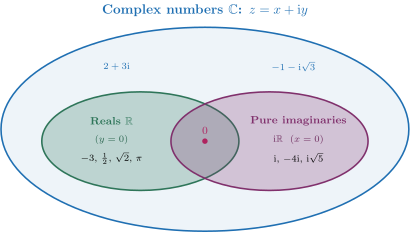
- If , then is a real number ().
- If , then is said to be pure imaginary. The set of pure imaginary numbers is denoted ().
For with , the imaginary part is the real number (the coefficient of ), and not . For example, for , we have and . Moreover, the number is the only complex number that is both real and pure imaginary: .
3.1.2 Equality of two complex numbers
Let and be two complex numbers written in algebraic form (with ). Then:
Two complex numbers are equal if and only if they have the same real part and the same imaginary part.
Proof
Suppose with , that is . If we had , we could divide by the nonzero real number and write , which contradicts the fact that (since ). Therefore necessarily , that is , and the equality then reduces to , that is . The converse is immediate.
Unlike , the set has no order relation compatible with addition and multiplication (in which every square would be positive, since ). A non-real complex number is neither positive nor negative, and an expression such as “” or “” only makes sense if the numbers considered are real numbers.
3.1.3 Addition, subtraction, multiplication and powers of
For all complex numbers and (with ):
- Addition and subtraction:
- Multiplication: expanding and replacing by ,
- Special products: for all ,
and, in particular, for all : .
The successive powers of are periodic with period . For every integer :
In particular, the sum of four consecutive powers of is always zero: .
Proof
We have , , , and . For every and every remainder of the Euclidean division of by , we have .
- Let us expand : .
- Let us calculate and :
We deduce, for example, .
- Let us calculate : the Euclidean division of by gives , so .
3.2 Conjugate of a complex number
3.2.1 Definition and first characterizations
Let be a complex number written in algebraic form (, ). The conjugate of , denoted (read “ bar”), is the complex number having the same real part and the opposite imaginary part:
Exercises of the chapter
- Algebraic form, quotients and powers solved
- Properties of the conjugate and equations in and solved
- Biquadratic equation in and factorization into real trinomials solved
- Square roots and second-degree equations with complex coefficients solved
- Polynomial of degree three with complex coefficients and triangle in the complex plane solved
- Geometric configurations, distances and circumscribed circle solved