Limits of a function at infinity
Course · Mathematics (Grade 11, Lebanon), chapter 4 · Lebanon, Grade 11 · the beginning of the chapter, the rest on Adloun
When a saline solution containing g of salt per liter is poured continuously into a tank initially filled with L of pure water, the salt concentration of the mixture increases with the volume poured , according to the law , without ever exceeding the ceiling value of g/L: when becomes very large, gets as close as we like to the number . Conversely, the area of a square with side eventually exceeds any threshold fixed in advance as grows indefinitely.
This chapter introduces the rigorous study of the behavior of a numerical function when the variable takes larger and larger positive values () or negative values (). It defines finite and infinite limits at infinity together with their geometric translation by horizontal and oblique asymptotes, then establishes the rules of operation on limits, the algebraic methods for removing indeterminate forms (factoring out the dominant term, conjugate expression), the highest-degree-term theorems for polynomial and rational functions, and finally the comparison and squeeze theorems at infinity.
Curriculum: LB-1S · LB-1H
Required skills
- Know the meaning of a finite or infinite limit at and at , and recognize the limits of the reference functions (, , , ).
- Interpret graphically the equality by the existence of a horizontal asymptote with equation , and study the relative position of the curve with respect to this asymptote.
- Apply the theorems on operations on limits (sum, product, inverse, quotient), identify the four indeterminate forms and remove them by factoring or by multiplying by the conjugate expression.
- Determine the limit at and at of a polynomial function or a rational function using the highest-degree terms.
- Prove that a line with equation is an oblique asymptote to the curve at , determine such an asymptote by division or identification and study the relative position of and its asymptote.
- Use the lower-bound, upper-bound and squeeze theorems to determine a limit at infinity, in particular when trigonometric functions are involved.
Throughout this chapter, the plane is equipped with an orthogonal coordinate system and denotes the representative curve of a function . Saying that a function is defined “in a neighborhood of ” (respectively “in a neighborhood of ”) means that it is defined on an interval of the form (respectively ).
4.1 Limit of a function at
4.1.1 Finite limit at and horizontal asymptote
Let be a function defined on an interval of the form and let be a real number. We say that tends to as tends to , or that has limit at , when every open interval containing contains all the values as soon as is large enough. We write:
In other words, the distance becomes as small as we like as soon as is chosen large enough.
When a function has a limit at , this limit is unique. Moreover, setting , we have the equivalence:
For every nonzero natural number :
Proof
Let be a real number as small as we like. For , the inequality is equivalent to , that is . As soon as exceeds the threshold , belongs to , hence . Similarly, for , we have , and for , we have , which establishes the other two limits.
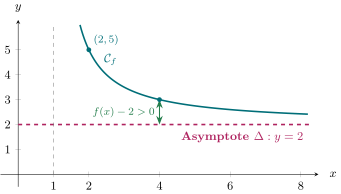
Let be a function defined on and let . If , we say that the line with equation is a horizontal asymptote to the representative curve in a neighborhood of (or at ).
Method : Studying the relative position of and its horizontal asymptote
To determine the position of the curve relative to its horizontal asymptote on an interval :
- We form the difference and reduce it to a common denominator or factor it.
- We study the sign of according to the values of :
- on the intervals where , the curve lies above ;
- on the intervals where , the curve lies below ;
- at the abscissas where , the curve crosses its asymptote .
Let be the function defined on by . As tends to , tends to , so tends to and . The line with equation is therefore a horizontal asymptote to at . Moreover, for every , we have : the curve lies strictly above the line on .
4.1.2 Infinite limit at
Let be a function defined on an interval of the form .
- We say that tends to as tends to , and we write , when every interval of the form (with as large as we like) contains all the values as soon as is large enough ( for large enough).
- We say that tends to as tends to , and we write , when (that is for every real threshold as soon as is large enough).
For every nonzero natural number :
Proof
Let be a fixed real number. For , since the square root function is increasing on , we get , so . Similarly, as soon as , we have for every , hence .
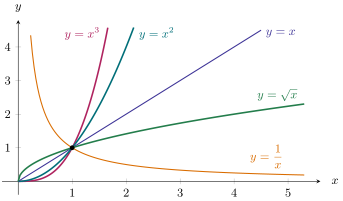
A function defined on may have neither a finite limit nor an infinite limit at . This is the case of the periodic functions and , which oscillate indefinitely between and without ever settling around a value or exceeding .
4.2 Limit of a function at
4.2.1 Finite and infinite limits at , horizontal asymptote
Let be a function defined on an interval of the form .
- We say that () when is as close to as we like as soon as is negative and large enough in absolute value ( with ). In this case, the line with equation is a horizontal asymptote to at .
- We say that (respectively ) when exceeds any fixed positive real number (respectively is less than any fixed negative real number ) as soon as is negative and large enough in absolute value.
Exercises of the chapter
- Polynomials and rational fractions: the law of the dominant term solved
- Horizontal asymptote and relative position of a rational curve solved
- Factoring under a radical at and at : the trap of solved
- Conjugate expression at when the dominant terms cancel out solved
- Comparison theorems and the squeeze theorem with and solved
- Canonical decomposition, oblique asymptote and relative position solved