Limit of a function at a point
Course · Mathematics (Grade 11, Lebanon), chapter 5 · Lebanon, Grade 11 · the beginning of the chapter, the rest on Adloun
When an object is brought close to the focal length of a converging lens, the position of its image on the optical axis, related to the position of the object by the conjugation formula , moves away indefinitely as soon as approaches : here an excluded value of the denominator produces a quantity that tends to infinity, which shows up on the curve as a vertical line that the curve runs along without ever crossing it. In other situations, as for the quotient near or near , the numerator and the denominator vanish simultaneously and the quotient gets close to a well-determined real number.
This chapter studies the behavior of a numerical function when the variable approaches a fixed real number , from below () or from above (). It successively defines infinite limits at a point and the vertical asymptote with equation , finite limits at a point and one-sided limits, operations on limits at a point and the algebraic methods for removing the indeterminate form “”, the comparison theorems as well as the reference trigonometric limits at (in the Sciences series), and finally the notion of continuity at a point and on an interval.
Curriculum: LB-1S · LB-1H
Required skills
- Determine the left-hand limit and the right-hand limit of a function at a point where its denominator vanishes; deduce the existence of a vertical asymptote with equation .
- Know the definition of a finite limit at a point , the uniqueness of the limit and the characterization by the equality of the left-hand and right-hand limits: .
- Apply the rules of operations on limits at and remove an indeterminate form “” by factoring out or by multiplying by the conjugate expression.
- Use the squeeze theorem at a point, prove geometrically and then apply the fundamental trigonometric limits at : , and (Sciences series).
- Study the continuity of a function at a point (in particular for a piecewise-defined function) and on an interval, and justify the continuity of the usual functions.
Throughout this chapter, the plane is equipped with an orthogonal coordinate system and denotes the representative curve of a function .
5.1 Infinite limit of a function at a point
5.1.1 Left-hand and right-hand infinite limits at
Let and let be a function defined in a neighborhood of , except possibly at .
- We say that tends to as tends to , and we write , when exceeds any real number fixed in advance as soon as is close enough to .
- We say that tends to as tends to , and we write , when .
- When we further require (respectively ), we speak of the right-hand limit at , written or (respectively of the left-hand limit at , written or ).
Let be a real number and let be a nonzero natural number.
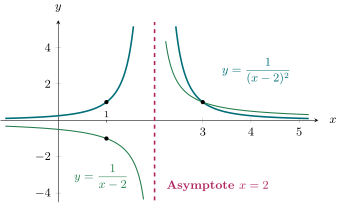
- For the function , the denominator is strictly negative for and strictly positive for :
- More generally, for the function :
- if is even, for every , so:
- if is odd, has the sign of , so:
- Finally, for the square root function: .
5.1.2 Graphical interpretation: vertical asymptote
When at least one of the limits or is equal to or to , we say that the line parallel to the -axis with equation is a vertical asymptote to the representative curve .
Method : Determining the limit of a quotient when and
To study the limit at of a quotient such that and :
- We determine the sign of .
- We draw up the sign table of the denominator near in order to know whether tends to (while remaining strictly positive) or to (while remaining strictly negative) as and as .
- We conclude for and using the rule of signs for a quotient, and we state that the line with equation is a vertical asymptote to .
Let be the function defined on by . As tends to , the numerator tends to and the denominator tends to . Now:
- for , we have , so and ;
- for , we have , so and .
The line with equation is therefore a vertical asymptote to the curve .
Exercises of the chapter
- Left-hand and right-hand limits at an excluded value and vertical asymptote solved
- Indeterminate form for a rational fraction: factoring by solved
- Indeterminate form with radicals: the conjugate expression at a point solved
- Trigonometric limits at by change of scale solved
- Joining a piecewise-defined function by continuity solved
- Continuity of the usual functions and continuity at a point by bounding solved