Differentiation
Course · Mathematics (Grade 11, Lebanon), chapter 6 · Lebanon, Grade 11 · the beginning of the chapter, the rest on Adloun
When a moving object travels along a straight path according to the time law , the quotient measures its average speed between the instants and . To know the speed shown by the speedometer at the precise instant , we must observe the limit of this rate as the time interval tends to . In geometry, the same passage to the limit makes the secant line through two points of a curve pivot to its limiting position: the tangent to the curve at the point .
This chapter introduces the concept of the derivative of a function at a point and its geometric interpretation as the slope of the tangent, the local linear approximation, the left-hand and right-hand derivatives (corner points, vertical half-tangents) as well as the fundamental link between differentiability and continuity. It then defines the derivative function and the second derivative on an interval, establishes from the definition the derivatives of all the usual functions (polynomials, reciprocal, square root, and trigonometric functions in the Sciences series), then proves the general formulas for differentiating a sum, a product, a reciprocal, a quotient and functions of the form , and .
Curriculum: LB-1S · LB-1H
Required skills
- Calculate the rate of change of a function at a point , deduce the derivative and determine an equation of the tangent .
- Use the linear approximation for close to .
- Study left and right differentiability at a point , recognize a corner point or a vertical half-tangent, and know that every function differentiable at is continuous at .
- Know and prove the formulas for the derivatives of the usual functions (, , , , , , and in the Sciences series , , ), stating the sets on which they are differentiable.
- Apply the rules for differentiating a sum, a product, a reciprocal and a quotient as well as the formulas , and , and calculate a second derivative .
Throughout this chapter, the plane is equipped with an orthogonal coordinate system and denotes the representative curve of a function .
6.1 Derivative of a function at a point
6.1.1 Rate of change and derivative at
Let be a function defined on an open interval and let .
- For every real number with (or setting with ), the quotient:
is called the rate of change (or difference quotient) of the function between and .
- We say that the function is differentiable at when this rate of change has a finite limit as tends to (that is, as tends to ). This limit is called the derivative of at and is written :
Let be the function defined on by . Let us calculate the derivative of at . We have , and for every :
As , we obtain . The function is therefore differentiable at and .
6.1.2 Geometric interpretation: equation of the tangent and linear approximation
Let be a fixed point of and a second point of (). The rate of change is the slope of the secant line . As tends to , the point approaches along and the secant pivots about toward a limiting position called the tangent to at .
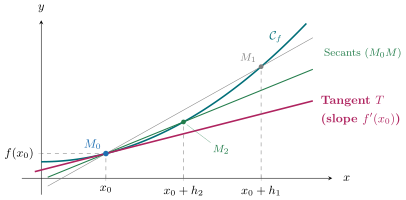
Let be a function differentiable at .
- The curve has at the point a tangent whose slope is the derivative .
- A Cartesian equation of this tangent is:
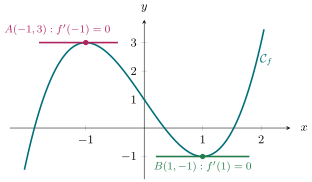
- In particular, if , the tangent at is horizontal (parallel to the -axis), with equation .
Proof
The tangent at the point is the line through with slope . Its slope-intercept equation is of the form . Since , its coordinates satisfy the equation: , hence . Substituting this expression for , we indeed obtain .
Let be a function differentiable at . There exists a function defined in a neighborhood of such that, for every close to :
For very close to , the term is negligible compared with , and we obtain the linear approximation of near (which consists in locally replacing the curve by its tangent):
Proof
For , let us set , and set . Then, for every close to , we indeed have , and by definition of the derivative , .
For at , we have and , so . The linear approximation at reads for close to . Thus, for , we obtain (the exact value being ).
6.1.3 Left and right differentiability, corner point, vertical half-tangent
Let be a function defined on an interval containing .
- We say that is differentiable from the left at if the left-hand limit exists and is finite. This limit is called the left-hand derivative of at and is written . The curve then has at a left half-tangent with equation ().
- We say that is differentiable from the right at if the right-hand limit exists and is finite. This limit is called the right-hand derivative of at and is written . The curve then has at a right half-tangent with equation ().
Exercises of the chapter
- Rate of change, equation of the tangent and linear approximation solved
- Left and right differentiability, corner point and vertical half-tangent solved
- Differentiating and factoring products, quotients and powers solved
- Derivatives of irrational functions and reduction to a common denominator solved
- Tangents through an external point and parallel tangents solved
- Trigonometric derivatives, factoring in and the oscillator differential equation solved