Continuity and the intermediate value theorem
Course · Mathematics (Grade 12 General Sciences, Lebanon), chapter 1 · Lebanon, Grade 12 General Sciences · the beginning of the chapter, the rest on Adloun
- Study the continuity of a function at a point (from the left and from the right) and on an interval, in particular for piecewise-defined functions.
- Justify the continuity of a function on an interval using the usual functions, algebraic operations and differentiability.
- Determine the image of a closed interval or of any interval under a continuous function using its table of variations ().
- Apply the intermediate value theorem and the bijection theorem (continuous and strictly monotonic function) to establish the existence and uniqueness of the solution of an equation or .
- Determine the sign of a continuous and strictly monotonic function from its unique root , and bound by bisection or by scanning.
- Study whether a function can be extended by continuity at a point where it is not defined.
In many physical or biological phenomena — the continuous change of a temperature, the growth of a bacterial population, the charging of a capacitor — a quantity varies without any sudden jump from an initial state to a final state: it then necessarily passes through all the intermediate values. The aim of this chapter is to formalize this fundamental property of functions that are continuous on an interval, to deduce from it rigorous criteria for the existence and uniqueness of the solutions of an equation of the form , and then to implement methods for bounding roots numerically and for extending functions by continuity.
Throughout this chapter, the plane is referred to an orthogonal coordinate system and denotes the representative curve of a real function .
1.1 Functions continuous on an interval and operations
1.1.1 Continuity at a point and on an interval
Let be a function defined on an interval and let .
- We say that is continuous at when:
- We say that is left-continuous at (when is defined to the left of ) if , and right-continuous at (when is defined to the right of ) if .
A function defined on an open interval containing is continuous at if and only if it is both left-continuous and right-continuous at , that is:
If this equality does not hold, we say that is discontinuous at .
Let and be two real numbers such that .
- A function is continuous on the open interval if it is continuous at every point .
- A function is continuous on the closed interval if it is continuous on , right-continuous at and left-continuous at .
- Continuity on , on , on or on is defined in the same way.
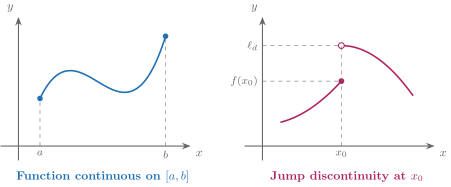
Graphically, saying that a function is continuous on an interval means that its representative curve over can be drawn “in a single stroke, without lifting the pencil”: it has neither a hole nor a vertical jump.
1.1.2 Link with differentiability and operations on continuous functions
Let be a function defined on an interval and let .
- If is differentiable at , then is continuous at .
- If is differentiable on the interval , then is continuous on .
Proof
Assume that is differentiable at . For every real number such that , we can write the identity:
By hypothesis, , and moreover . By the product of limits:
The function is therefore continuous at .
A function can be continuous at a point without being differentiable there:
- the absolute value function is continuous at but is not differentiable at (its left derivative equals and its right derivative equals : corner point);
- the square root function is continuous on (hence right-continuous at ), but is differentiable only on (its curve has a vertical half-tangent at ).
- Reference functions:
- every polynomial function, as well as the functions , and , is continuous on ;
- every rational function (quotient of two polynomials) is continuous on each interval contained in its domain;
- the function is continuous on .
- Algebraic operations: let and be two functions continuous on the same interval and let .
- The functions , , and () are continuous on .
- If does not vanish at any point of , then and are continuous on .
- If for every , then is continuous on .
Exercises of the chapter
- Left continuity, right continuity and joining the pieces solved
- Extension by continuity and differentiability of the extension solved
- Image of an interval and number of solutions of an equation with a parameter solved
- Auxiliary function, implicit root and sign of a derivative solved
- Locating a root by bisection and by decimal scanning solved
- Fixed point theorem on a closed interval and intersection of two curves solved