Composite functions and inverse functions
Course · Mathematics (Grade 12 General Sciences, Lebanon), chapter 2 · Lebanon, Grade 12 General Sciences · the beginning of the chapter, the rest on Adloun
- Determine the domain, the limit, the continuity and the direction of variation of a composite function .
- Compute the derivative of a composite function using the formula and its special cases (, , , , ).
- Justify that a function continuous and strictly monotonic on an interval has an inverse function defined on , and state the continuity and the direction of variation of .
- Determine, when algebra allows it, the explicit expression of for every .
- Study the differentiability of at a point and compute without necessarily finding explicitly.
- Draw the representative curve from by reflection in the first bisector, the line with equation , in an orthonormal coordinate system.
In analysis, most of the functions we meet are not simple algebraic combinations of the elementary functions, but result from applying two or more transformations one after another: we then speak of composition of functions. Moreover, when a functional relation is bijective on an interval, it becomes natural to swap the roles of the variable and of the image in order to express in terms of : this is the notion of inverse function, which in the following chapters will give rise to the exponential function (inverse of the natural logarithm) and to the inverse trigonometric functions (, , ).
Throughout this chapter, the plane is equipped with an orthonormal coordinate system .
2.1 Composition of functions
2.1.1 Definition and domain of a composite function
Let and be two real functions with respective domains and . The composite function of followed by , denoted (read “ composed with ”), is the function defined by:
Its domain consists of the real numbers belonging to whose image belongs to :
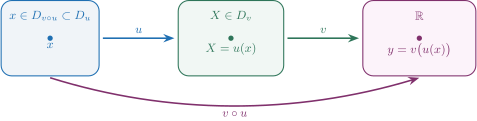
In general, the order of the functions is essential: . For example, if and on , then , whereas .
Let () and (). Let us determine the function and its domain .
For every , we have .
2.1.2 Limit, continuity and direction of variation of a composite function
Let and be two functions, and let , , be three elements, each denoting either a real number, or , or . If:
then the composite function has limit at :
- If is continuous at a point and if is continuous at the point , then the composite function is continuous at .
- If is continuous on an interval and if is continuous on an interval containing (), then is continuous on .
Let be a function monotonic on an interval and let be a function monotonic on an interval such that .
- If and have the same direction of variation (both increasing or both decreasing), then is increasing on .
- If and have opposite directions of variation, then is decreasing on .
Moreover, if and are strictly monotonic, then is strictly monotonic.
Proof
Let be such that .
- If is decreasing on and is decreasing on , then in . Since reverses the order on , the inequality implies , which proves that is increasing on .
- If is increasing on and is decreasing on , then , so is decreasing on .
2.2 Differentiation of composite functions and applications
Let be a function defined on an interval and let be a function defined on an interval containing .
- If is differentiable at and if is differentiable at , then the composite function is differentiable at and:
- If is differentiable on and if is differentiable on , then is differentiable on and:
Exercises of the chapter
- Domain, limits and direction of variation of a composite function solved
- Differentiating composite functions and study of a trigonometric function solved
- Bijection, explicit computation of the inverse and symmetry of the curves solved
- Differentiating an inverse function that cannot be found algebraically solved
- -th roots, rational exponents and irrational equations solved
- Trigonometric bijection and inverse function solved