Second derivatives, convexity and L'Hôpital's rule
Course · Mathematics (Grade 12 General Sciences, Lebanon), chapter 3 · Lebanon, Grade 12 General Sciences · the beginning of the chapter, the rest on Adloun
- Apply L'Hôpital's rule (once or several times) to resolve indeterminate forms of the type “” and “”.
- Compute the second derivative and the successive derivatives of a function on an interval.
- Study the convexity and the concavity of a function on an interval from the sign of its second derivative or from the direction of variation of its first derivative .
- Interpret convexity and concavity geometrically through the relative position of the curve with respect to its secants (chords) and its tangents, and deduce inequalities from them.
- Determine the points of inflection of a curve from the change of sign of and write the equation of the tangent at the point of inflection.
While the sign of the first derivative tells us about the direction of variation of a function — that is, whether its representative curve rises or falls — it says nothing about the way this curve bends: does it open upward or downward? To answer this geometric and physical question (which corresponds in mechanics to the sign of the acceleration), we introduce the second derivative , which measures the rate of change of the slope of the tangents. This chapter also presents a powerful and direct analytical tool from differential calculus: L'Hôpital's rule, which makes it possible to resolve the indeterminate forms “” and “” efficiently.
Throughout this chapter, the plane is referred to an orthogonal coordinate system .
3.1 L'Hôpital's rule
3.1.1 Principle and statement of L'Hôpital's rule
Consider two functions and differentiable at a real number such that . As tends to , the quotient takes the indeterminate form “”. Dividing the numerator and the denominator by , we bring out the difference quotients of the two functions at :
If , taking the limit as immediately gives .
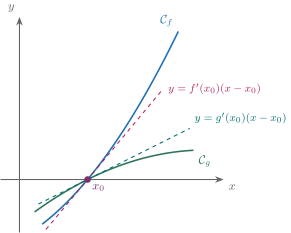
This result generalizes to the case where and are not evaluated at , as well as to limits at infinity and to the indeterminate form “”:
Let and be two functions differentiable on a punctured open interval with endpoint (where denotes a real number , , , or ), such that does not vanish in a neighborhood of . Assume that:
- (indeterminate form “”),
or (indeterminate form “”); - the quotient of the derivatives has a limit (finite or infinite: or ) as tends to .
Then the quotient also has the limit as tends to :
3.1.2 Implementation, iterations and precautions for use
Method : Using L'Hôpital's rule correctly
- Essential preliminary check: before any differentiation, check explicitly that and do lead to one of the two indeterminate forms “” or “”.
- Mind the formula: we differentiate the numerator and the denominator separately to form (we do not differentiate the quotient with the formula ).
- Iterating the rule: if the new quotient still takes an indeterminate form “” or “” and and are differentiable, we may apply L'Hôpital's rule a second time by studying .
- Transforming other indeterminate forms:
- a form “” for reduces to “” or “” by writing or ;
- a form “” between fractions often reduces to “” by putting everything over a common denominator.
- Quotient that is not indeterminate: for , the numerator tends to and the denominator to , so the limit is directly . If we mistakenly differentiated the numerator and the denominator, we would obtain here by pure chance, but for , the ratio of the derivatives would give !
- Case where has no limit: L'Hôpital's rule is an implication (), but its converse is false. For example, as , tends to (by the squeeze theorem), whereas the ratio of the derivatives has no limit at .
Exercises of the chapter
- L'Hôpital's rule: forms , iterations and transformation of and solved
- Successive derivatives and proof by induction solved
- Study of convexity, points of inflection and crossing of the tangent solved
- Convexity of a rational function and study of the points of inflection solved
- Position with respect to tangents and chords: classic inequalities solved
- L'Hôpital's rule with parameters and determination of constants solved