Conditional probability and total probability
Course · Mathematics (Grade 12 General Sciences, Lebanon), chapter 13 · Lebanon, Grade 12 General Sciences · the beginning of the chapter, the rest on Adloun
When a random experiment takes place in several stages, or when partial information about the outcome is revealed during the observation, the assessment of the chances that an event occurs must be revised in light of what is already known. Drawing a second ball from an urn without having put the first one back, interpreting the positive result of a biological test while taking into account the prevalence of the characteristic studied, or assessing the reliability of an electronic component coming from several production lines: in all these situations, the initial sample space shrinks to the subset of outcomes compatible with the information acquired.
This chapter introduces conditional probability , the compound probability formula and its representation by weighted trees, then characterizes the independence of two events, carefully distinguishing it from incompatibility. It concludes with the total probability formula on a partition of the sample space and with Bayes' formula, which makes it possible to go back from observed effects to probable causes.
Curriculum: LB-SG
Required skills
- Calculate the conditional probability of an event given that an event of nonzero probability has occurred.
- Construct and use a two-way table or a weighted tree to model a conditioning.
- Apply the compound probability formula .
- Recognize two independent events by the relation or , use the independence of complementary events, and distinguish independence from incompatibility.
- Use a partition of the sample space to apply the total probability formula and reverse the conditioning with Bayes' formula.
13.1 Conditional probability
13.1.1 Definition and set-theoretic interpretation
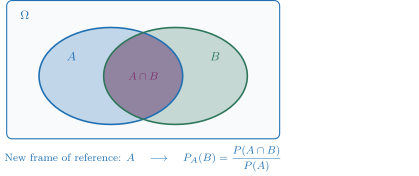
Let be the sample space associated with a random experiment, equipped with a probability . When we learn that an event (such that ) has occurred, the outcomes lying outside become impossible: everything happens as if became the new reference sample space, and only the outcomes of that also belong to — that is, those of — now contribute to the occurrence of .
Let and be two events of the same sample space such that . The conditional probability of given (or probability of given that has occurred) is the real number, denoted or , defined by:
If the sample space is finite and equipped with the uniform probability (equally likely outcomes), then for every nonempty event and every event :
Proof
Under the hypothesis of equiprobability on , we have and . Forming the quotient and canceling , we get:
In other words, in the sub-sample space , itself equipped with equiprobability, is the ratio of the number of outcomes favorable to to the number of outcomes of .
A pharmaceutical laboratory analyzes a batch of ampoules coming from two workshops and . Some ampoules have a dosage defect (event ). The distribution of the ampoules is summarized below:
| Workshop | Workshop | Total | |
|---|---|---|---|
| Defective () | |||
| Conforming () | |||
| Total |
An ampoule is picked at random from the (equiprobable situation).
- The probability that the ampoule comes from and is defective is .
- The probability that the ampoule is defective given that it comes from is read in the column of :
- Conversely, the probability that the ampoule comes from given that it is defective is read in the row of :
The previous example illustrates an essential distinction when reading problem statements:
- refers to the whole set of ampoules (“among all the ampoules, what is the share of those that come from and are defective?”);
- restricts the population to the ampoules of (“among the ampoules of , what is the proportion of defective ampoules?”);
- restricts the population to the defective ampoules (“among the defective ampoules, what is the proportion coming from ?”).
13.1.2 Properties of conditional probability
Let be an event such that . The map that associates with every event is a probability on . In particular, for all events , and :
- Bounds and normalization: , and .
- Complementary event: .
- Union of two events: . In particular, if and are incompatible (), then .
Exercises of the chapter
- Two-way frequency table, conditional probabilities and independence test solved
- Characterization of independence, complementary events and incompatibility solved
- Successive draws without replacement and compound probabilities solved
- Partition into three events, total probability and Bayes' formula solved
- Two-stage experiment with a transfer between two urns solved
- Spam filter and predictive value with a parameter solved