Discrete real random variables
Course · Mathematics (Grade 12 General Sciences, Lebanon), chapter 14 · Lebanon, Grade 12 General Sciences · the beginning of the chapter, the rest on Adloun
In many random experiments, it is not the raw outcome itself that directly interests the observer, but a numerical quantity derived from it: the sum of the points obtained by rolling two dice, the net gain of a participant in a game of chance, the number of defective parts in a sample taken from a production line, or the number of successes when the same trial is repeated. Associating in this way a real number with each outcome of the sample space leads to the notion of a real random variable.
This chapter presents discrete real random variables defined on a finite sample space, their probability distribution and their expected value, then develops the variance, the standard deviation, the cumulative distribution function and the binomial distribution.
Curriculum: LB-SG
Required skills
- Determine the set of values taken by a discrete real random variable and establish its probability distribution .
- Calculate the expected value of a random variable and interpret it as an average value or as a fairness criterion for a game.
- Calculate the variance (by definition or by the König-Huygens formula ) and the standard deviation .
- Determine and represent the cumulative distribution function , and recover the probability distribution of from .
- Recognize a Bernoulli scheme and apply the binomial distribution .
14.1 Random variable and probability distribution
14.1.1 Definition, image set and associated events
Let be the finite sample space associated with a random experiment, equipped with a probability .
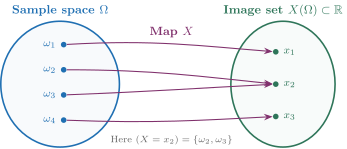
- A real random variable (abbreviated r.r.v.) defined on is any map that associates a real number with each outcome .
- The finite set of real values actually taken by , arranged in strictly increasing order , is called the image set of and is denoted :
For every real number and every real number , we write for short:
- or for the event (set of outcomes giving the value );
- for the event , and similarly , , or .
Since each outcome has a unique image , the events are nonempty, pairwise incompatible, and their union is : they form a complete system of events (a partition) of .
14.1.2 Probability distribution of a random variable
Let be a random variable on taking the values (). Defining the probability distribution of means associating with each value the probability:
The probability distribution of is usually presented in the form of a summary table:
| Values taken by | Total | ||||
|---|---|---|---|---|---|
| Probability |
The probabilities () of a random variable satisfy:
Proof
For every , is the probability of an event of , so . Moreover, since the family forms a partition of , the additivity of the probability gives:
Exercises of the chapter
- Probability distribution with parameters and linearity of expectation solved
- Simultaneous draw from an urn and search for a fair stake solved
- Two-stage experiment, total probability and expected value solved
- Reconstructing a distribution from its cumulative distribution function, variance and standard deviation solved
- Bernoulli scheme, binomial distribution and minimum sample size solved
- Identifying a binomial distribution and comparison with a draw without replacement solved