Elements of logic and propositional calculus
Course · Mathematics (Grade 12 General Sciences, Lebanon), chapter 15 · Lebanon, Grade 12 General Sciences · the beginning of the chapter, the rest on Adloun
Every mathematical proof rests on a precise language whose rules make it possible to chain statements together without ambiguity and to distinguish valid reasoning from a faulty deduction. Whether one studies the convergence of a sequence, the differentiability of a function or the intersection of planes in space, the logical structure of the statements — connectives, quantifiers, implications and equivalences — remains the same.
This chapter presents the foundations of propositional calculus and predicate calculus: truth values, universal and existential quantifiers, negation of a statement, logical operators (, , , ) and truth tables. It then establishes the main logical laws (De Morgan's laws, the law of contraposition, distributivity) on which the essential methods of reasoning in mathematics are based: direct proof, proof by contrapositive, proof by contradiction, proof by cases, counterexample and proof by induction.
Curriculum: LB-SG
Required skills
- Recognize a logical proposition and a predicate and determine their truth value; handle the universal () and existential () quantifiers.
- Form the negation of a compound proposition and the negation of a quantified statement containing one or more quantifiers.
- Construct the truth tables of the fundamental logical connectives (negation, conjunction, disjunction, implication, equivalence) and interpret an implication in terms of necessary condition and sufficient condition.
- Establish that a propositional formula is a tautology and use the logical laws (De Morgan's laws, negation of an implication, contrapositive, distributivity) to transform or simplify a statement.
- Apply the method of reasoning suited to a mathematical question: direct proof, proof by contrapositive, proof by contradiction, proof by cases, counterexample or proof by induction.
15.1 Propositions, truth values and quantifiers
15.1.1 Propositions and fundamental principles of two-valued logic
A proposition (or statement) is a mathematical statement with a precise meaning to which one can assign, without any ambiguity, one and only one of the two truth values:
- True (denoted or );
- False (denoted or ).
Classical mathematical logic rests on two fundamental principles:
- Principle of non-contradiction: no proposition can be both true and false.
- Law of the excluded middle: every proposition is either true or false; there is no third possibility.
- The statement : “ is a prime number” is a true proposition (truth value ).
- The statement : “ is a rational number” is a false proposition (truth value ).
- The statement : “” is a true proposition.
- On the other hand, a question (“Is the real number positive?”), a command (“Solve the equation”) or an expression containing an unspecified free variable (“”) are not propositions as long as the variable is neither fixed nor quantified.
15.1.2 Predicates and truth set
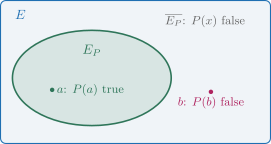
Let be a nonempty set, called the universe (or domain of discourse). A predicate (or property, or propositional form) defined on is a statement containing a variable such that, as soon as is replaced by a specific element , the statement becomes a proposition with a well-defined truth value.
The truth set (or solution set) of the predicate in is the subset of made up of the elements that make true:
Similarly, predicates in several variables are defined on a Cartesian product .
15.1.3 Universal and existential quantifiers
To turn a predicate defined on a set into a genuine proposition (whose truth value no longer depends on ), the variable is bound by means of a quantifier.
Let be a predicate defined on a universe .
- Universal quantifier (): the proposition
is read “for every belonging to , is true” (or “for all , ”). It is true when all the elements of satisfy , that is, when .
- Existential quantifier (): the proposition
is read “there exists at least one belonging to such that is true”. It is true when at least one element of satisfies , that is, when .
- Existence and uniqueness (): the proposition
is read “there exists a unique such that is true”. It is true when the truth set is a singleton ().
- In a quantified proposition such as “”, the letter is a bound variable (or dummy variable): it can be replaced by any other unused letter (“”) without changing the meaning or the truth value of the statement.
- When two quantifiers of the same kind follow each other, they can be swapped: “” has the same meaning as “”.
- On the other hand, and cannot be swapped without profoundly changing the meaning of the statement:
- In “”, the real number is chosen after and may depend on (for example ): this proposition is true (the set is not bounded above).
- In “”, one and the same real number fixed in advance would have to be strictly greater than all real numbers (including ): this proposition is false.
15.2 Negation of a proposition
15.2.1 Negation of a proposition
Let be a proposition. The negation of , denoted or (and read “not ”), is the proposition that is true when is false, and false when is true. Its truth table is:
The third column immediately shows the law of double negation: the proposition always has the same truth value as .
In terms of predicates on a universe , the truth set of the predicate is the complement of the truth set of . In particular, the negation of a strict inequality between real numbers is the non-strict inequality , and the negation of is .
15.2.2 Negation of quantified propositions
Denying that all the elements of have a property amounts exactly to asserting that there exists at least one element of that does not have it (a counterexample). Similarly, denying that there exists an element satisfying amounts to asserting that all the elements satisfy .
Let be a predicate defined on a set .
- The negation of a universal proposition is an existential proposition:
- The negation of an existential proposition is a universal proposition:
More generally, to negate a statement containing a sequence of quantifiers, each is replaced by and each by (keeping the membership sets ), and the final predicate is replaced by its negation.

Let be a numerical function.
- The statement “ is the zero function” is written: “”. Its negation (“ is not the zero function”) is:
Caution: the negation is certainly not “”!
- The statement “ is bounded above on ” is written: “”. Its negation (“ is not bounded above on ”) is obtained by switching each quantifier and negating the final inequality:
- The statement “ is increasing on ” is written: “”. Its negation is the existence of two real numbers and such that and .
Exercises of the chapter
- Truth set of a predicate and order of the quantifiers solved
- Negating quantified statements and refuting by counterexample solved
- Truth tables, necessary condition and sufficient condition solved
- Tautologies, De Morgan's laws and algebraic simplification of formulas solved
- Proof by contrapositive and proof by contradiction solved
- Proof by cases and proof by induction solved