Complex numbers in geometry
Course · Mathematics (Grade 12 General Sciences, Lebanon), chapter 21 · Lebanon, Grade 12 General Sciences · the beginning of the chapter, the rest on Adloun
Since the complex plane was introduced by Caspar Wessel and Jean-Robert Argand at the dawn of the XIXth century, complex numbers have formed an outstanding bridge between algebraic computation and plane geometry. To each point or vector of the plane equipped with a direct orthonormal coordinate system there corresponds a unique complex number, its affix. From then on, the fundamental geometric quantities — distances, midpoints, centroids and above all directed angles of vectors — translate directly into moduli, arguments and quotients of complex numbers.
This chapter systematically uses the modulus and the argument to solve the classical problems of plane geometry: after recalling the geometric interpretation of elementary operations on affixes and establishing the meaning of the modulus and argument of the difference , we study the quotient , the true keystone for characterizing the collinearity of three points, the orthogonality of two lines, the nature of a triangle (isosceles, right, equilateral) and the concyclicity of four points, before determining a variety of loci (perpendicular bisectors, circles, lines, rays and arcs subtending a given angle).
Curriculum: LB-SG
Required skills
- Determine the affix of a vector , of the midpoint of a segment, of the centroid of a triangle or of a linear combination of vectors.
- Interpret geometrically the modulus as the distance and the argument as a measure of the directed angle .
- Use the modulus and argument of the quotient (or ) to compute a ratio of lengths and a measure of the directed angle (or ).
- Characterize with complex numbers the collinearity of three points, the parallelism and orthogonality of two lines, the nature of a triangle and the concyclicity of four points.
- Determine and represent loci of points defined by a condition on a modulus or an argument.
21.1 Geometric interpretations of operations on complex numbers
Throughout this chapter, the plane , called the complex plane (or Argand-Cauchy plane), is referred to a direct orthonormal coordinate system .
21.1.1 Affix of a point, affix of a vector and linear operations
With every complex number (with ), we associate the unique point with coordinates in the coordinate system , that is, such that .
- The point is called the image point of , and the vector is the image vector of .
- Conversely, the complex number is called the affix of the point (written ) and also the affix of the vector (written ).
We often write for the point with affix . The axis is the real axis and the axis is the imaginary axis.
Let and be two vectors of the complex plane, and and two points with respective affixes and .
- Equality: .
- Sum and multiplication by a real number: for all real numbers , the affix of the vector is:
- Affix of a vector : the vector has affix:
- Midpoint of a segment: the midpoint of the segment has affix:
- Centroid of a triangle: the centroid of a triangle (with affixes ) has affix:
Proof
The first two properties follow immediately from the linearity of coordinates in the coordinate system . By Chasles' relation, , hence . The midpoint of is characterized by , that is, , which gives . Finally, the centroid of the triangle satisfies , which translates on the affixes into , that is, .
Four points , , and form a parallelogram if and only if , which is equivalent to , or to the equality of the affixes of the midpoints of the diagonals: .
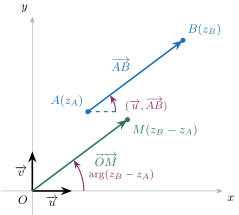
21.1.2 Distance between two points and angle of a vector with
Let and be two points of the complex plane with respective affixes and .
- The distance is equal to the modulus of the difference of the affixes:
- If , the directed angle between the unit vector and the vector has as a measure the argument of :
Proof
Let be the unique point of the plane such that . By definition of the affix of a vector, the point has affix . On the one hand, since translations preserve distances, . On the other hand, when , the point is distinct from the origin and, by the geometric definition of the argument of a nonzero complex number, . Since , we conclude that .
Exercises of the chapter
- Equilateral triangle, centroid and rhombus in the complex plane solved
- Collinearity, orthogonality and concyclicity of four points solved
- Loci defined by moduli and arguments solved
- Study of a homographic transformation and loci solved
- The complex inversion : images of lines and circles solved
- Equilateral triangles constructed on two sides of a triangle solved