Dilations of the plane
Course · Mathematics (Grade 12 General Sciences, Lebanon), chapter 22 · Lebanon, Grade 12 General Sciences · the beginning of the chapter, the rest on Adloun
In geometrical optics, in architecture or in cartography, enlarging or reducing a figure from a fixed viewpoint without altering its shapes or proportions comes down to one and the same fundamental geometric transformation: the dilation, also called homothety, a term introduced by the mathematician Michel Chasles in the XIXth century. Closely linked to the intercept theorem (Thales' configuration), a dilation expands or contracts distances by a constant ratio while preserving parallelism, directed angles and ratios of lengths.
This chapter develops the complete study of the dilations of the plane: after stating the definition, specifying the special cases and determining the inverse transformation, we establish the characteristic vector property and its consequences for the preservation of collinearity, of barycenters and of directed angles, as well as for the effect on lengths and areas. We then determine the images of the usual figures (lines, segments, rays, circles) and the dilations mapping one circle onto another, before studying the group of dilations and translations (composition of two dilations, or of a dilation and a translation) and its applications to loci, construction problems and concurrent lines.
Curriculum: LB-SG
Required skills
- Construct the image of a point under a dilation with given center and ratio; recognize a dilation in a geometric configuration (intercept theorem, trapezoid, medial triangle) and determine its characteristic elements.
- Use the characteristic vector property to recognize a dilation or a translation and to prove that two lines are parallel or that three points are collinear.
- Use the preservation properties of a dilation (collinearity, midpoint, barycenter, parallelism, orthogonality, directed angles, tangency) as well as its effects on lengths () and areas ().
- Determine the image of a line, a segment, a ray or a circle under a dilation; determine the centers of dilation (direct and inverse) mapping a given circle onto another.
- Determine the nature and characteristic elements of the composition of two dilations or of a dilation and a translation; apply dilations to finding loci and to construction problems.
22.1 Definitions and properties
22.1.1 Definition, special cases and invariant points
Let be a fixed point of the plane and a nonzero real number (). The dilation with center and ratio , written (or simply ), is the transformation of the plane that maps every point to the unique point such that:
The point is the center of the dilation and the nonzero real number is its ratio.
- If , for every point , , that is, : the dilation is the identity map of the plane, written .
- If , for every point , , that is, is the midpoint of the segment : the dilation is the point reflection with center , written .
- If , the vectors and are collinear and point in the same direction ( lies on the ray when ); the dilation is said to be positive (or direct).
- If , the vectors and are collinear and point in opposite directions ( lies on the segment ); the dilation is said to be negative (or inverse).
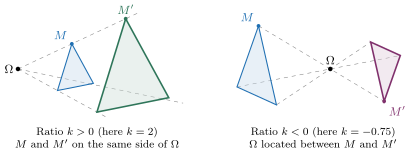
Let be a dilation with center and ratio .
- Invariant points: if , the center is the only invariant point of (). If , every point of the plane is invariant.
- Fundamental collinearity: for every point of the plane and its image , the three points , and are collinear. Conversely, every line through the center is globally invariant under .
- Inverse transformation: the dilation is a bijection of the plane onto itself, and its inverse transformation is the dilation with the same center and ratio :
Proof
- A point is invariant under if and only if , that is, . When , we have , hence , that is, .
- The relation expresses the collinearity of the vectors and , hence the collinearity of , and .
- Since , for all points and of the plane:
22.2 The characteristic vector property and preservation properties
22.2.1 The characteristic vector property
- If is the dilation with center and ratio , then for all points and of the plane with respective images and , we have:
- Conversely, let be a transformation of the plane and a nonzero real number such that, for all points and with images and , we have :
- if , then is a translation (by the vector , which is the same for every );
- if , then is a dilation with ratio whose center is the unique invariant point of .
Proof
- Let and . By definition, and . Using Chasles' relation through :
- Conversely, assume that for all points , we have . Fix a point of the plane and write .
- If , then for every point , , which by the parallelogram rule is equivalent to : is the translation by the vector .
- If , let us look for an invariant point (). Such a point necessarily satisfies . Decomposing by Chasles' relation:
This point exists and is unique. For this point , its image satisfies , hence . Finally, applying the hypothesis to the pair , we obtain for every point : is indeed the dilation .
Exercises of the chapter
- Vector characterization, center and ratio of a dilation solved
- Dilations in a trapezoid and collinearity of the midpoints of the bases solved
- Finding loci with dilations solved
- Internally tangent circles and homothetic chords solved
- Composition of dilations and point reflections in a triangle solved
- Geometric construction problems with dilations solved