Direct plane similitudes and complex forms
Course · Mathematics (Grade 12 General Sciences, Lebanon), chapter 23 · Lebanon, Grade 12 General Sciences · the beginning of the chapter, the rest on Adloun
The translations, rotations and dilations studied earlier share an essential geometric property: they preserve the shape of figures as well as the orientation of the angles of the plane. Composing a dilation and a rotation yields a more general transformation called a direct plane similitude, which combines in a single motion a change of scale (multiplication of distances by a strictly positive ratio ) and a change of orientation by a constant angle . In the complex plane, these geometric transformations have a strikingly simple algebraic translation: they correspond exactly to the complex affine functions (, ).
This chapter brings together the geometric study of direct plane similitudes and the algebraic study of the complex forms of transformations: after establishing the complex expressions of the usual transformations (translation, dilation, rotation, reflection in the real axis), we define direct plane similitudes, determine their canonical reduced form and their characteristic elements, then study their geometric properties, their determination by two points and their images, and directly similar triangles, before drawing up the complete classification of the transformations with complex expression and of their compositions.
Curriculum: LB-SG
Required skills
- Give and recognize the complex expression of a translation, a dilation, a rotation and the reflection in the real axis.
- Define a direct plane similitude by its ratio and its angle , and use its canonical decomposition (reduced form) into a dilation and a rotation with the same center .
- Use the geometric properties of direct similitudes (preservation of directed angles, collinearity, barycenters and contact; images of lines and circles; multiplication of distances by and of areas by ).
- Determine the unique direct similitude mapping a pair of points () to a pair of points (), and characterize directly similar triangles.
- Determine the nature and characteristic elements (ratio, angle, center) of any transformation with complex expression (), as well as of the inverse and of the composition of two direct similitudes.
23.1 Complex form of a transformation
Throughout this chapter, the plane is equipped with a direct orthonormal coordinate system . To every transformation that maps the point to the point corresponds a function such that , called the complex form (or complex expression) of the transformation .
23.1.1 Translation, dilation and rotation
Let be a point of the complex plane and its image.
- Translation: the translation by the vector with affix has complex expression:
- Dilation: the dilation with center and ratio has complex expression:
- Rotation: the rotation with center and angle has complex expression:
Proof
- By definition, .
- Similarly, (since is real).
- For the rotation , the center is invariant ( for , which the formula satisfies). For every point , by definition of the rotation:
Since a complex number with modulus and argument equals , this condition is equivalent to , that is, .
23.1.2 Reflection in the real axis and special cases
- The reflection (or orthogonal symmetry) in the real axis has complex expression:
- The reflection in the imaginary axis has complex expression .
- The point reflection with center (case or ) has complex expression , that is, .
- The counterclockwise and clockwise quarter turns with center () have the respective complex expressions and .
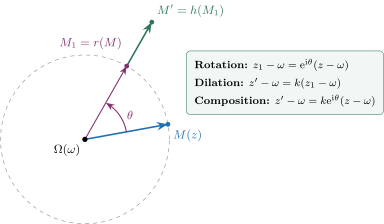
- Let us determine the complex expression of the rotation with center and angle , then the image of the point . We have . For , , so:
- The dilation with center and ratio has complex expression , that is, .
23.2 Definitions
23.2.1 Similitudes, rigid motions and direct similitudes
- A transformation of the plane is called a similitude with ratio () if it multiplies distances by , that is, if for all points and with images and , we have:
- A similitude with ratio is called a direct plane similitude if it also preserves directed angles of vectors: there exists a real number such that, for all distinct points and with images and , we have:
The real number is the ratio of the direct similitude , and the real number (defined modulo ) is its angle. We say that is a direct similitude with ratio and angle , denoted , or when it has a center .
Exercises of the chapter
- Classification and characteristic elements of complex transformations solved
- Direct similitude defined by two pairs of points solved
- Analytic expression, complex expression and images of figures solved
- Sequence of points generated by a direct similitude solved
- Locus of a vertex and of the centroid of a moving similar triangle solved
- Rotations and direct similitudes in an equilateral triangle solved