Inverse trigonometric functions
Course · Mathematics (Grade 12 General Sciences, Lebanon), chapter 6 · Lebanon, Grade 12 General Sciences · the beginning of the chapter, the rest on Adloun
Objectives and required skills
- Know the definition, the domain, the codomain, the parity, the direction of variation and the representative curve of the three inverse trigonometric functions , and .
- Master the special values, the composition formulas (, ) and the fundamental identities ( on , on ).
- Know the derivatives of , and as well as those of the composite functions , and , paying attention to the domain of differentiability when the argument reaches .
- Recognize and compute the antiderivatives of functions of the type and ().
Since the circular functions , and are periodic on their domains, they are not injective and therefore have no global inverse function. However, by restricting each of them to a suitably chosen interval on which it is continuous and strictly monotonic while taking every value of its range, we obtain three fundamental bijections whose inverse functions — arcsine, arccosine and arctangent — play an essential role in geometry, in trigonometry and in computing antiderivatives of rational and irrational functions.
6.1 The arcsine function
6.1.1 Definition and immediate properties
The sine function is continuous on the closed interval and differentiable on , with for every . It is therefore strictly increasing on and is a bijection from onto .
The arcsine function, denoted , is the inverse function of the restriction of the sine function to the interval . It is defined on with values in by the equivalence:
In other words, for every , is the unique real number in whose sine is equal to .
- Inverse relations:
- Parity: the function is odd on :
- Cosine and tangent of :
Proof
- These two identities directly express the fact that is the inverse bijection of .
- Let and let . Then and , which by definition is equivalent to , that is, .
- For every , let . On the interval , the cosine is nonnegative (). From the fundamental relation , we therefore get . For , and .
The equality holds only if . When , we must first bring the angle back into the principal interval using the formulas and . For example:
6.1.2 Variations, derivative and representative curve of
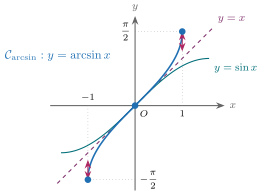
- The function is continuous and strictly increasing on the closed interval .
- The function is differentiable on the open interval and, for every :
- However, is differentiable neither at nor at : its representative curve has vertical half-tangents at the endpoints and . At the origin , the tangent has equation , and:
Proof
As the inverse of a continuous and strictly increasing function, is continuous and strictly increasing on . For every , we have , so that the derivative is positive. By the theorem on the derivative of an inverse function, is differentiable at and:
At the endpoints , and , hence the vertical half-tangents.
Exercises of the chapter
- Reduction to the principal interval and trigonometric compositions solved
- Equations and inequalities involving , and solved
- Simplification by differentiation of a rational composite with solved
- An identity linking and , and computing limits solved
- Antiderivatives reducing to and by completing the square solved
- Study of a function combining and a radical solved