Numerical sequences: limits and convergence
Course · Mathematics (Grade 12 General Sciences, Lebanon), chapter 7 · Lebanon, Grade 12 General Sciences · the beginning of the chapter, the rest on Adloun
Since Antiquity, the approximation of geometric or numerical quantities — such as computing a square root by Heron's method, or bounding by regular polygons inscribed and circumscribed in Archimedes' work — has relied on building an infinite succession of real numbers that come closer and closer to a target value. In economics, demography and physics, the period-by-period evolution of capital invested at compound interest, of a loan repaid by constant annual installments or of a population subject to regular renewal is naturally modeled by a numerical sequence .
This chapter first consolidates the study of the direction of variation of sequences and the fundamental formulas for arithmetic and geometric sequences, then introduces the notions of sequences bounded above, bounded below and bounded. It then develops the theory of the limit of a sequence (finite or infinite), algebraic operations on limits and the asymptotic behavior of geometric sequences . Finally, it establishes the major theorems on the existence and bounding of limits: the monotone convergence theorem, the squeeze theorem, the theorem on adjacent sequences and the complete study of sequences defined by a recurrence relation .
Curriculum: LB-SG
- Study the direction of variation of a numerical sequence and use the formulas for the general term and for the sum of consecutive terms of an arithmetic or geometric sequence.
- Prove that a sequence is bounded above, bounded below or bounded by direct computation, by bounding, by studying a function or by induction.
- Determine the limit (finite or infinite) of a numerical sequence using reference limits, operations on limits, factoring out the dominant term and the study of .
- Use the monotone convergence theorem to prove the convergence of an increasing sequence bounded above or a decreasing sequence bounded below without knowing its limit in advance.
- Apply passing to the limit in inequalities, the squeeze theorem, adjacent sequences and the fixed-point theorem for recursive sequences .
7.1 Review
7.1.1 Generalities and direction of variation of a numerical sequence
A numerical sequence is a function defined on the set of natural numbers (or on the set of natural numbers , where ) with values in . The image of the integer is denoted (rather than ) and is called the general term (or term of index ) of the sequence, while the sequence itself is denoted or .
- Explicit definition: the general term is expressed directly in terms of the index by a relation of the form , where is a function defined on .
- Recursive definition: the sequence is given by its first term and by a recurrence relation that makes it possible to compute each term step by step from the previous one.
Let be a numerical sequence.
- The sequence is said to be increasing (resp. strictly increasing) from index onward if, for every integer , we have (resp. ).
- The sequence is said to be decreasing (resp. strictly decreasing) from index onward if, for every integer , we have (resp. ).
- The sequence is said to be monotonic (resp. strictly monotonic) from index onward if it is increasing or decreasing (resp. strictly increasing or strictly decreasing) from index onward.
- The sequence is said to be constant (or stationary) from index onward if, for every integer , we have .
Method : Studying the direction of variation of a sequence
To determine the direction of variation of a sequence , four classic procedures are available:
- Studying the sign of the difference (general method): we compute and factor (or put over a common denominator) the difference . If for every , the sequence is increasing; if , it is decreasing.
- Comparing the quotient with (for a sequence with positive terms): once we have checked that for every , and when involves products, powers or factorials, we compare with :
- Studying the associated function when : if is a monotonic function on the interval , then the sequence defined by has the same direction of variation as .
- Proof by induction when : if the function is increasing on an interval containing all the terms of the sequence, then is monotonic and its direction of variation is given by the sign of (since , that is, ).
- Let be defined by . For every integer :
The sequence is therefore strictly increasing.
- Let be defined by . For every , we have and:
Now, for every , we have , so , whereas . The sequence is therefore strictly increasing from index onward.
- Let be defined by . The function is differentiable on and for every (since ). The sequence is therefore strictly decreasing from index onward (and since , it increases from to and then decreases for ).
7.1.2 Arithmetic sequences and geometric sequences
Let be a numerical sequence.
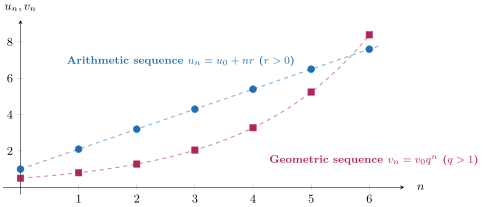
- Arithmetic sequence with common difference : the sequence satisfies for every .
- General term: for all natural numbers and , .
- Direction of variation: is strictly increasing if , constant if , strictly decreasing if .
- Sum of consecutive terms: for all integers , the sum of the consecutive terms from to is:
In particular, the sum of the first nonzero natural numbers is .
- Geometric sequence with common ratio : the sequence satisfies for every .
- General term: for all natural numbers and , .
- Sum of consecutive terms (for ): for all integers , the sum of the consecutive terms from to is:
In particular, for , (and if , this sum equals ).
Method : Studying an arithmetic-geometric sequence (, )
To express the general term in terms of when with :
- We determine the unique fixed point satisfying , that is, .
- We introduce the auxiliary sequence defined for every by .
- We prove that is geometric with common ratio :
- We express , then deduce .
7.2 Sequences bounded above – sequences bounded below
Let be a numerical sequence.
- The sequence is said to be bounded above if there exists a real number such that, for every integer , we have . The real number is then called an upper bound of the sequence.
- The sequence is said to be bounded below if there exists a real number such that, for every integer , we have . The real number is then called a lower bound of the sequence.
- The sequence is said to be bounded if it is both bounded above and bounded below, that is, if there exist two real numbers and such that, for every integer , we have .
A sequence is bounded if and only if there exists a nonnegative real number such that:
Proof
If for every , then , so is bounded below by and bounded above by . Conversely, if for every , then setting , we have , that is, .
- If is an upper bound of , every real number is also an upper bound of . Likewise, if is a lower bound of , every real number is also a lower bound of .
- Every sequence that is increasing from index onward is automatically bounded below by its first term (since for every ). Every sequence that is decreasing from index onward is automatically bounded above by its first term (since for every ).
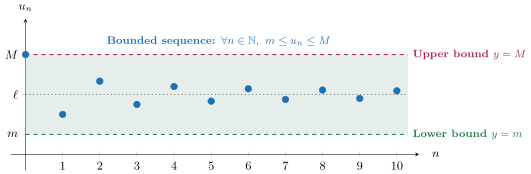
- Let be defined by . For every , we have and , so : the sequence is bounded below by . Moreover, let us study the difference:
so for every . Thus, the sequence is bounded: .
- Let be defined by . For every integer , we have , hence . Since , we obtain:
The sequence is therefore bounded, bounded below by and bounded above by .
7.3 Limit of a sequence
7.3.1 Finite limit, infinite limit, convergence and divergence
Unlike a function of a real variable , whose limit can be studied at a real number or at , the index of a numerical sequence can only tend to . When we speak of the limit of a sequence , we therefore always mean its limit as tends to .
Exercises of the chapter
- Linear recursive sequence with an affine right-hand side, and a sum solved
- Resolving indeterminate forms, and a homographic sequence with a double fixed point solved
- A sum with a variable number of terms and the bounding theorem solved
- A telescoping sum and the monotone convergence of a sum of reciprocals of cubes solved
- Adjacent sequences and bounds for a numerical constant solved
- A recursive sequence and the fixed-point theorem solved