Combinations and the binomial theorem
Course · Mathematics (Grade 12 Life Sciences, Lebanon), chapter 10 · Lebanon, Grade 12 Life Sciences · the beginning of the chapter, the rest on Adloun
Whether it is a matter of forming a committee of people chosen from an assembly of members, drawing a handful of balls simultaneously from an urn, counting the diagonals of a convex polygon or expanding an integer power , one and the same mathematical object systematically appears: the number of subsets of cardinality of a finite set of cardinality , called a combination of elements from and denoted or . A central tool of combinatorics and algebra, it is also the foundation of probability on finite equiprobable sample spaces.
This chapter first defines combinations and establishes their factorial expression from arrangements and permutations. It then proves the fundamental properties of binomial coefficients — symmetry and Pascal's rule — which make it possible to build Pascal's triangle, and then establishes the binomial theorem and its algebraic and set-theoretic consequences. Finally, it presents methods for modeling and counting with combinations, distinguishing precisely between simultaneous draws, successive draws without replacement and successive draws with replacement.
Curriculum: LB-SV
Required skills
- Define a combination of elements of a set with elements and compute the binomial coefficient .
- Prove and use the symmetry property and Pascal's rule ; build and use Pascal's triangle.
- State and apply the binomial theorem to expand and , find a particular term of the expansion and compute sums of binomial coefficients ().
- Model a counting situation (simultaneous draws, unordered choices without replacement, committees, geometric figures) and choose rigorously between combinations, arrangements, permutations and -lists.
10.1 Combinations
10.1.1 Review of factorials, permutations and arrangements
Let be a natural number and let be a finite set of cardinality .
- The factorial of , denoted , is the integer defined by and, for every :
- For , an arrangement of elements of is a -tuple of pairwise distinct elements of (the choice takes order into account and is made without repetition). The number of arrangements of elements from , denoted , is equal to:
- A permutation of is an arrangement of the elements of . The number of permutations of a set with elements is equal to .
10.1.2 Definition and number of combinations
In many situations, we wish to select distinct elements from without attaching any importance to the order in which they are chosen: the appropriate mathematical object is no longer an ordered -tuple, but a subset of cardinality .
Let be a finite set of cardinality and let be a natural number.
- A combination of elements of (or -combination of ) is any subset of having exactly elements.
- The number of combinations of elements of a set with elements is denoted or (and is read “ choose ” or “, , ”).
When , there is no subset of containing elements, so .
Let be a set with elements.
- The triples , , , , and are six distinct arrangements of elements of , since the order of the components of a triple matters.
- On the other hand, the sets , and are equal and form one and the same combination of elements of , since in a set, the order in which the elements are written does not matter and the elements are pairwise distinct.
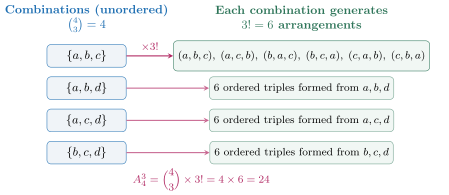
For all natural numbers and such that , the number of combinations of elements from is given by:
Proof
Let be a set with elements and let . To form an arrangement of elements of , we can proceed in two successive and independent steps:
- choose the unordered subset of cardinality in : by definition, there are possible choices;
- order these chosen elements to form a -tuple: there are exactly possible permutations of these elements.
Since each arrangement of elements of is obtained in one and only one way by this procedure, the multiplication principle gives , hence:
For , the only subset of with elements is the empty set , so , which agrees with the formula since .
Exercises of the chapter
- Factorial simplifications and equations involving binomial coefficients solved
- Pascal's rule and telescoping sums solved
- Expanding with Newton's binomial theorem and finding particular terms solved
- Computing sums of binomial coefficients solved
- Counting committees with constraints and incompatibilities solved
- A reasoned comparison of the three drawing protocols solved