Second-order linear differential equations
Course · Mathematics (Grade 12 Life Sciences, Lebanon), chapter 9 · Lebanon, Grade 12 Life Sciences · the beginning of the chapter, the rest on Adloun
Newton's fundamental principle of dynamics, which relates the force applied to a point mass to its acceleration — that is, to the second derivative of its position with respect to time —, as well as Kirchhoff's voltage law in an electric circuit containing an inductor, a capacitor and a resistor (an circuit), naturally lead to second-order differential equations. Depending on the values of the physical parameters, one and the same type of equation describes a return to equilibrium without oscillation just as well as damped oscillations or sustained harmonic oscillations.
This chapter presents second-order linear differential equations with constant coefficients and the structure of their set of solutions. It first deals with equations of the type by double integration, then with the complete solution of the homogeneous equation () using the discriminant of its characteristic equation . Finally, it studies the harmonic oscillator equation , equations with a simple right-hand side, and finding the unique solution satisfying two initial conditions and .
Curriculum: LB-SV
Required skills
- Solve a differential equation of the type on an interval by two successive antiderivative computations.
- Form the characteristic equation associated with () and write the general solution on according to the sign of the discriminant (, , ).
- Solve equations of the type and () and write a solution in the form .
- Find a particular solution of a second-order equation with a simple right-hand side and deduce the general solution .
- Find the unique solution satisfying the initial conditions and , and interpret these two conditions geometrically on the integral curve.
Throughout this chapter, the plane is equipped with an orthogonal coordinate system .
9.1 Second-order linear differential equations with constant coefficients
9.1.1 Definitions
Let , , be three real numbers with , and let be a function continuous on an interval of .
- The differential equation:
is called a second-order linear differential equation with constant coefficients with right-hand side .
- A solution of on is a function , twice differentiable on , such that, for every , .
- The equation is called the equation without right-hand side (or homogeneous equation) associated with .
9.1.2 Structure of the solutions and the second-order Cauchy problem
Let be a second-order linear differential equation on an interval , and let be the associated homogeneous equation.
- Linearity of : if and are two solutions of on , then for all real numbers and , the linear combination is again a solution of on .
- Adding a particular solution: if is a particular solution of on , then a function twice differentiable on is a solution of if and only if is a solution of . In other words, the solutions of on are the functions:
where ranges over the set of solutions of the homogeneous equation .
Proof
- Let be two solutions of and . Let . By linearity of first and second differentiation:
- Since on , we have, for every function twice differentiable on :
which means exactly that is a solution of .
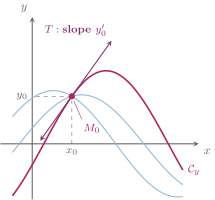
Since the general solution of a second-order differential equation depends on two arbitrary real constants and , selecting a unique solution requires two initial conditions: the value of the function and that of its first derivative at the same point .
Let with and continuous on . For every and every pair , there exists a unique solution of on satisfying both initial conditions simultaneously:
Geometrically, this means that there exists a unique integral curve passing through the point and having at the line with slope as its tangent.
Exercises of the chapter
- Equation of the type by double integration and a prescribed tangent solved
- Homogeneous equations: the three regimes of the discriminant and Cauchy problems solved
- Harmonic oscillator with a constant right-hand side and the amplitude-phase form solved
- A second-order equation with a polynomial right-hand side solved
- Exponential right-hand side: the non-resonant case and the resonant case solved
- Trigonometric right-hand side and the steady state solved