Electric current
Course · Physics (Grade 11 Humanities, Lebanon), chapter 1 · Lebanon, Grade 11 Humanities · the beginning of the chapter, the rest on Adloun
A lamp that lights up, a phone that charges, an iron that heats up: behind each of these everyday actions, an electric current flows in wires. We cannot see it, but we observe its effects. What actually moves in a copper wire? How is a current measured? Why do we say that the battery of a remote control supplies a direct current while the wall socket supplies an alternating current, and what do the markings “ – ” written on appliances mean? This chapter answers these questions, starting from familiar objects.
Curriculum: LB-1H
Required skills
- Describe the electric current as a movement of electrons in a metal and of ions in a solution; indicate the conventional direction of the current in a circuit.
- Connect an ammeter in series, express a current in amperes and use the relation .
- Recognize the four effects of the electric current (thermal, luminous, chemical, magnetic) in common appliances.
- Distinguish a direct current from an alternating current; read on an oscillogram the period and the maximum value of a voltage, then calculate its frequency .
- Relate the effective value to the maximum value of an alternating voltage () and know the characteristics of the mains voltage (, ).
1.1 The nature of the electric current
1.1.1 A closed circuit, conductors and insulators
For a flashlight to shine, you need a battery, a lamp, wires and a closed switch: together they form an unbroken loop called an electric circuit. As soon as the switch is opened, the loop is broken and the lamp goes out: the current flows only in a closed circuit.
Not all materials let the current through. Metals (copper, aluminum, iron), the graphite of a pencil lead and salt water are conductors. Plastic, glass, rubber, dry wood and air are insulators: this is why copper wires are covered with a plastic sheath.
1.1.2 What moves: electrons or ions
The electric current is a collective movement of particles carrying an electric charge.
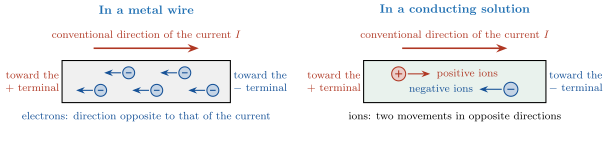
- In a metal, it is electrons that move. Each electron carries a negative charge. The atoms of the metal stay in place.
- In a conducting solution (salt water, the liquid of a car battery), there are no free electrons: it is ions that move. Positive ions go in one direction, negative ions in the opposite direction.
Without a generator, the electrons of a wire jiggle in all directions and there is no current. When the wire is connected to the two terminals of a battery, all the electrons are set in motion in the same direction: they are repelled by the negative terminal () of the battery and attracted by its positive terminal ().
1.1.3 The conventional direction of the current
The direction of the current was chosen at the beginning of the 19th century, long before the electron was discovered. This choice has been kept.
Outside the generator, the electric current flows from the positive terminal () to the negative terminal (). On a diagram, it is represented by an arrow placed on the wire and labeled .
In a metal, the electrons therefore move in the direction opposite to the conventional direction of the current. In a solution, positive ions move in the conventional direction and negative ions in the opposite direction.
1.2 The current in a circuit
1.2.1 The current and its measurement
The flow rate of a faucet indicates the quantity of water that flows out each second. In the same way, the current in a circuit indicates the quantity of electricity that passes through the wire each second: the larger it is, the more electrons pass each second.
The current is denoted . It is expressed in amperes (symbol ). For small currents, the milliampere is used:
| Appliance or phenomenon | Order of magnitude of the current |
|---|---|
| LED lamp in a home | (that is, ) |
| Phone charger | to |
| Iron | to |
| Car starter motor | a few hundred amperes |
| Lightning bolt | several tens of thousands of amperes |
Exercises of the chapter
- The circuit of a flashlight solved
- The ammeter and the string of lights solved
- Charging a phone solved
- Which effect for which appliance? solved
- Reading an oscillogram solved
- The mains voltage solved