Transformer and power transmission
Course · Physics (Grade 11 Humanities, Lebanon), chapter 2 · Lebanon, Grade 11 Humanities · the beginning of the chapter, the rest on Adloun
A phone charger is plugged into a socket, but the phone receives only a few volts. Along the roads, tall pylons carry cables at hundreds of thousands of volts, whereas the sockets of the house deliver only . In both cases, the same device, with no moving part, changes the value of the voltage: the transformer. How is it made? Why does it work only with alternating current? And why is such a high voltage needed to transmit electrical energy from the power station to the homes?
Curriculum: LB-1H
Required skills
- Describe how a transformer is built: two coils and a laminated iron core.
- Explain its principle qualitatively and know that it works only with alternating current.
- Use the transformation ratio ; recognize a step-up or a step-down transformer.
- Use the relation of the ideal transformer.
- Calculate the Joule-effect losses in a line () and explain the advantage of high voltage for the transmission of electrical energy.
- Describe the chain that links the power station to the home.
2.1 The transformer
2.1.1 How it is built
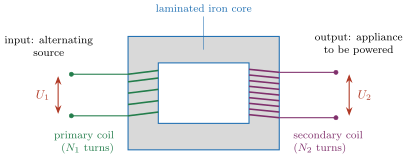
A transformer has only three parts:
- a primary coil, made of turns of insulated copper wire; it is the coil connected to the source of alternating voltage;
- a secondary coil, made of turns; the appliance to be powered is connected across its terminals;
- an iron core, shaped like a closed frame, around which the two coils are wound. This core is laminated: it is made of thin iron sheets stacked and insulated from one another, which limits its heating.
The two coils do not touch: no wire connects the primary to the secondary. We denote by the voltage across the primary (input voltage) and by the voltage across the secondary (output voltage). Since these voltages are alternating, and denote their effective values.
2.1.2 Principle: a device for alternating current
The electric current has a magnetic effect. When a current flows through the primary coil, it magnetizes the iron core, like an electromagnet.
- If the current is alternating, it constantly changes value and direction: the magnetization of the core therefore also varies constantly. The core carries this varying magnetization to the secondary coil. Now, a magnetization that varies inside a coil makes a voltage appear across its terminals. An alternating voltage thus appears at the secondary, although no wire connects it to the primary.
- If the current is direct, the magnetization of the core does not vary: no voltage appears at the secondary.
- A transformer works only with alternating current. Connected to a battery, it delivers no voltage.
- It changes the value of the voltage, but it does not change its frequency: if the input voltage is at , so is the output voltage.
Connected to a battery, the primary coil behaves like a simple copper wire: a very large current flows through it, it heats up strongly and can be destroyed, without anything appearing at the secondary.
2.2 The relations of the transformer
2.2.1 The transformation ratio
Experiment shows that the output voltage depends on the numbers of turns of the two coils: if the secondary has twice as many turns as the primary, the output voltage is twice the input voltage; if it has ten times fewer, the output voltage is ten times smaller.
The voltages across the two coils are proportional to their numbers of turns:
This quotient is called the transformation ratio. The output voltage follows: .
Exercises of the chapter
- The parts of a transformer solved
- Step-up or step-down? solved
- The charger of a drill solved
- The transformer of an electric train solved
- The losses of a power line solved
- From the power station to the socket solved