Domestic electricity and its dangers
Course · Physics (Grade 11 Humanities, Lebanon), chapter 3 · Lebanon, Grade 11 Humanities · the beginning of the chapter, the rest on Adloun
At home, electricity is everywhere: it lights, heats, cools, washes, recharges. Each appliance carries a small plate covered with markings, and every month a bill arrives showing a number of “kilowatt-hours”. Behind the walls run wires of different colors, and a distribution board groups devices that sometimes “trip”. What exactly do we pay for on an electricity bill? How are the appliances connected? Why can the mains current kill, and how does a well-designed installation protect people and the house?
Curriculum: LB-1H
Required skills
- Read the rating plate of an appliance; use the relation for a heating appliance.
- Calculate an electrical energy in joules and in kilowatt-hours; read a bill and calculate the running cost of an appliance.
- Recognize the three wires of an installation (phase, neutral, ground) and explain why appliances are connected in parallel.
- Describe the dangers of the current for the human body (electric shock, electrocution) and for the installation (short circuit, overload).
- Explain the role of the fuse, the circuit breaker, the residual current device () and the ground connection; list the safety rules.
3.1 Electric power and energy
3.1.1 The power of an appliance
A kettle boils a liter of water in two or three minutes; a bottle warmer takes much longer. The kettle is more powerful: it converts more electrical energy each second. Electric power is denoted and expressed in watts (symbol ) or in kilowatts: .
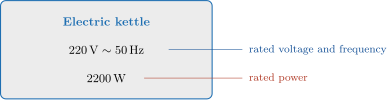
Each appliance carries a rating plate showing its rated voltage, the voltage at which it must be connected, and its rated power, the power it receives when it works at this voltage.
| Appliance | Order of magnitude of the power |
|---|---|
| LED lamp | |
| Television | |
| Refrigerator | |
| Iron | |
| Air conditioner | |
| Kettle, water heater |
A heating appliance (heater, iron, kettle, water heater, oven) connected at a voltage and carrying a current receives the power
with in volts (), in amperes () and in watts (). For the mains, and are the effective values. The current follows: .
The kettle of the plate above has a rated power at . The current flowing through it is . An LED lamp draws only : the more powerful an appliance, the larger the current flowing through it.
3.1.2 The electrical energy consumed
What we consume, and pay for, is not the power but the energy: it depends on the power of the appliance and on how long it runs.
An appliance of power running for a time consumes the energy
- With in watts and in seconds, is in joules (symbol ).
- With in kilowatts and in hours, is in kilowatt-hours (symbol ).
The joule is a very small unit for household uses; the kilowatt-hour is the unit of meters and bills. One kilowatt-hour is the energy consumed in one hour by a appliance:
Method : Calculating an energy in kilowatt-hours
- Express the power in kilowatts: divide the watts by .
- Express the time in hours (; ).
- Multiply: .