Sources and aspects of light
Course · Physics (Grade 11 Humanities, Lebanon), chapter 4 · Lebanon, Grade 11 Humanities · the beginning of the chapter, the rest on Adloun
The Sun rising over the mountain, the living-room lamp, the screen of a phone, the red beam of a laser pointer: light surrounds us, and it is through light that we know the world. Where does it come from? Why can we see the Moon even though it produces no light? What is special about the light of a laser? Why does a rainbow appear after the rain, and how does a screen make all the colors with only three of them? This chapter answers these questions, starting from what we observe every day.
Curriculum: LB-1H
Required skills
- Distinguish a primary light source from a diffusing object; recognize an incandescent source and a luminescent source.
- State the properties of laser light, some of its uses and the safety rules.
- Know that light travels in a straight line in a transparent and homogeneous medium; know the speed of light in vacuum and use the relation .
- Describe the dispersion of white light by a prism and give the order of the colors of the visible spectrum.
- Predict the color obtained by superimposing red, green and blue lights (additive synthesis).
- Explain the color of an object by the absorption and the diffusion of light, and predict the effect of a colored filter.
4.1 Light sources
4.1.1 Primary sources and diffusing objects
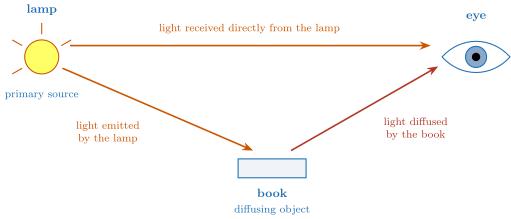
In a room in complete darkness, nothing can be seen: neither the furniture, nor the walls, nor your own hands. If a lamp is switched on, everything appears. The lamp produces light; the furniture and the walls merely send back part of the light they receive.
- A primary source of light produces the light it emits by itself: the Sun, the stars, a flame, a lamp that is on, a screen that is on, a laser.
- A diffusing object (or secondary source) produces no light: it sends back in all directions part of the light it receives. It is said to diffuse light. The Moon, the planets, clouds, a wall, a page of a book are diffusing objects.
The Moon shines in the night sky, but it produces no light: it diffuses toward the Earth part of the light it receives from the Sun. A movie screen is also a diffusing object: it sends the light of the projector back toward the audience.
An object is seen only if light coming from this object enters the eye. A primary source sends its light directly toward the eye; a diffusing object must first be lit.
4.1.2 Two ways of producing light
Not all primary sources work in the same way. The filament of an old bulb is scorching hot; the screen of a phone remains almost cold. Two families are distinguished.
- An incandescent source emits light because it is very hot. Examples: the Sun, a candle flame, embers, the lava of a volcano, the filament of an incandescent lamp.
- A luminescent source emits light without needing to be very hot: this is called “cold light”. Examples: an LED lamp, a fluorescent tube, the screen of a phone or of a television, a laser, a glowworm.
A piece of iron being heated first turns dark red, then orange, then dazzling white: the hotter an incandescent body, the whiter and more intense its light.
An incandescent lamp converts most of the electrical energy it receives into heat: it gives little light and heats a lot. An LED lamp, a luminescent source, provides the same lighting while consuming much less electrical energy, and it lasts much longer. This is a significant saving on the electricity bill.
4.2 A special source: the laser
Invented in 1960, the laser is everywhere: store checkouts, printers, operating rooms, shows, communication networks. Its light resembles that of no lamp.
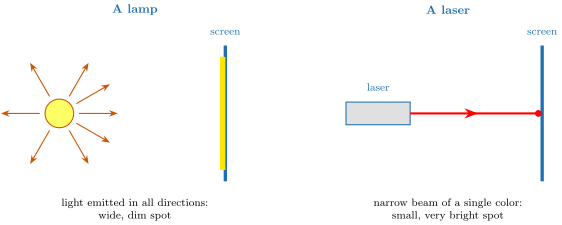
- A single color. The light of a laser has a perfectly pure color: it is said to be monochromatic. The light of an ordinary lamp, on the contrary, is a mixture of colors.
- A single direction. The beam of a laser is very narrow and widens very little: it remains almost as narrow several tens of meters away. A lamp, on the other hand, lights in all directions.
- Concentrated energy. All the light of the laser arrives on a tiny spot. Even a low-power laser therefore lights very strongly the small point it reaches.
These properties explain the many uses of the laser.
- In everyday life: reading barcodes at checkouts, laser printers, disc players, pointers for presentations, builders' laser levels for drawing a perfectly straight line.
- In communications: in an optical fiber, laser light carries phone calls and Internet data.
- In medicine: eye surgery, laser scalpels that cut without bleeding, skin treatments.
- In industry: very precise cutting and welding of metals, distance measurement.
Exercises of the chapter
- A full-moon night solved
- The laser at the store checkout solved
- The path of light solved
- The prism and the rainbow solved
- The pixels of a television solved
- The flag under the spotlights solved