Electromagnetic waves
Course · Physics (Grade 11 Humanities, Lebanon), chapter 5 · Lebanon, Grade 11 Humanities · the beginning of the chapter, the rest on Adloun
We listen to the radio in the car, warm up a dish in the microwave oven, change channels with a remote control, send a message with a phone, have an X-ray after a fall: each time, an electromagnetic wave is at work. These waves are almost all invisible, and yet the light that lights our way belongs to the same family. What do they have in common? What distinguishes them? Which ones are useful, which ones are dangerous, and how can we protect ourselves from them? This chapter presents this large family, from radio waves to gamma rays.
Curriculum: LB-1H
Required skills
- Know that an electromagnetic wave travels without a material medium, at the speed in vacuum.
- Define the wavelength and the frequency of a wave; use the relation .
- Know that visible light is an electromagnetic wave, with a wavelength between about and .
- List in order the seven domains of the electromagnetic spectrum: radio waves, microwaves, infrared, visible, ultraviolet, X-rays, rays.
- Associate a source and a common use with each domain.
- Know the dangers of ultraviolet rays, X-rays and rays, the role of the ozone layer and the means of protection.
5.1 What is an electromagnetic wave?
5.1.1 Waves that travel without a medium
When a pebble is thrown into a pond, circular ripples move away from the point where it fell: this is a wave. The water does not move along with the ripples (a cork floating on the surface goes up and down on the spot), but energy is carried from one point to another. The ripples need water to exist, just as sound needs air.
Electromagnetic waves also carry energy without carrying matter, but they have a special property: they need no medium at all. The light of the Sun and that of the stars reach us after crossing space, which is practically empty.
An electromagnetic wave is an electric and magnetic vibration that travels. It carries energy without carrying matter. It travels in transparent media and in vacuum: it does not need a material medium.
Visible light, the waves of radio and of the phone, the microwaves of the oven and the X-rays of radiography are all electromagnetic waves.
In vacuum, all electromagnetic waves travel at the same speed, that of light:
In air, their speed is practically the same.
A telecommunications satellite is above the Earth. A signal sent from the ground takes
to reach it. The signal then comes back down toward another point on the ground: it takes another . This is the origin of the slight delay sometimes noticed during a live TV link.
In space, two astronauts can see each other perfectly, because light crosses vacuum; but they cannot hear each other directly, because sound does not travel in vacuum. They talk to each other using radio waves, which are electromagnetic waves.
5.2 Wavelength and frequency
5.2.1 Two quantities to describe a wave
All electromagnetic waves have the same nature and the same speed in vacuum. What distinguishes a radio wave from an X-ray is its frequency, and therefore its wavelength.
- The frequency of a wave is the number of vibrations it makes each second. It is expressed in hertz (symbol ).
- The wavelength (Greek letter “lambda”) is the distance between two neighboring crests of the wave. It is expressed in meters ().
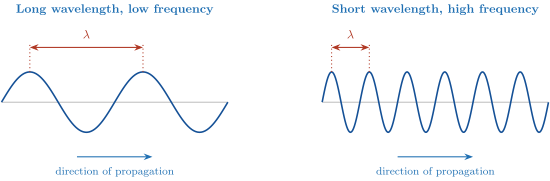
The frequencies of electromagnetic waves are often very high, and their wavelengths sometimes very small. Multiples of the hertz and submultiples of the meter are therefore used.
Exercises of the chapter
- Two astronauts on the Moon solved
- Two radio stations solved
- The microwave oven solved
- Completing the spectrum solved
- Each wave has its use solved
- The Sun, ultraviolet and the ozone layer solved