Optical systems
Course · Physics (Grade 11 Humanities, Lebanon), chapter 6 · Lebanon, Grade 11 Humanities · the beginning of the chapter, the rest on Adloun
Glasses resting on a nose, a watchmaker's magnifying glass, the lens of a phone taking a photograph, and above all our eye: all these optical systems form images, and all use the same component, the lens. How can a lens that “enlarges” be told apart from a lens that “shrinks”? Where does the image form, and why is it sometimes upside down? How does the eye manage to see sharply a distant mountain as well as the lines of a book? What exactly do the glasses of a nearsighted person correct? This chapter answers these questions through observation and drawing, without complicated calculations.
Curriculum: LB-1H
Required skills
- Recognize a converging lens and a diverging lens, by touch and by their effect on a light beam.
- Locate the optical center, the optical axis and the focal points of a lens; relate the focal length and the vergence (or optical power) , expressed in diopters.
- Construct the image of an object formed by a converging lens using the three special rays; say whether the image is real or virtual, upright or inverted, larger or smaller than the object.
- Explain how the magnifying glass and the camera work.
- Describe the eye and its model (the reduced eye); explain accommodation; define the punctum proximum and the punctum remotum.
- Recognize myopia, hyperopia and presbyopia, and state the lens that corrects each of these defects.
6.1 Lenses
6.1.1 Two families of lenses
A lens is a block of glass or of transparent plastic with at least one face that is bulging or hollowed. On passing through it, light changes direction, as it does every time it passes from air into glass. Two families are distinguished, and they are easy to recognize.
- A converging lens is thicker at the center than at the edges: its edges are thin. It narrows a light beam.
- A diverging lens is thinner at the center than at the edges: its edges are thick. It widens a light beam.
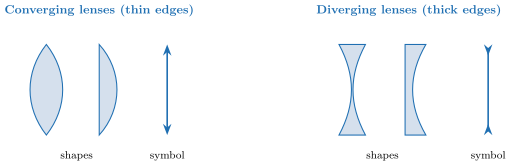
Method : Recognizing a lens
- By touch. Pinch it gently between the thumb and the index finger, at the center then at the edge: thin edges, it is converging; thick edges, it is diverging.
- By looking at a text. Place it near a page: if the letters look bigger, it is converging; if they look smaller, it is diverging.
- With sunlight. A converging lens concentrates the light into a small, very bright spot on a sheet of paper; a diverging lens never does.
6.1.2 Optical center, optical axis and focal points
On a diagram, a lens is represented by its symbol: a line ending in two arrows. On it, we locate:
- the optical center , in the middle of the lens;
- the optical axis, the straight line that passes through and is perpendicular to the lens.
By convention, light goes from left to right.
Let us send onto a lens a beam of rays parallel to the optical axis, like those coming from the Sun or from a very distant object.
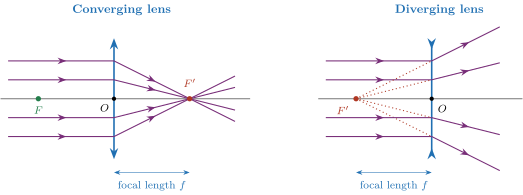
- After a converging lens, the rays that arrived parallel to the optical axis all pass through the same point of the axis: the image focal point . The point , placed on the other side at the same distance from , is the object focal point.
- After a diverging lens, these rays spread out as if they all came from a point located in front of the lens: this is its image focal point.
- The focal length is the distance between the optical center and a focal point: .
To measure the focal length of a converging lens, form on a sheet of paper the image of a very distant object (the Sun, a faraway building): the distance between the lens and the sheet, when the image is sharp, is the focal length. The more bulging a converging lens, the shorter its focal length and the more strongly it narrows the light.
6.1.3 Vergence
Opticians do not speak of focal length but of vergence: it is the number written on the prescription for a pair of glasses.
The vergence of a lens is the inverse of its focal length:
with in meters () and in diopters (symbol ).
The greater the vergence, the shorter the focal length: the lens then deviates light strongly. To distinguish the two families, the vergence is given a sign by convention: positive for a converging lens, negative for a diverging lens. A lens marked is therefore converging, a lens marked is diverging.
- A converging lens has a focal length . In meters, . Its vergence is .
- A magnifying glass has a vergence . Its focal length is , that is, .
The magnifying glass, with the greater vergence, has the shorter focal length.
6.2 The image formed by a converging lens
6.2.1 Object and image
Let us place a lit candle in front of a converging lens, then move a sheet of paper on the other side: for a certain position of the sheet, the flame appears on it, sharp and upside down. This is the image of the flame formed by the lens. The flame is the object.
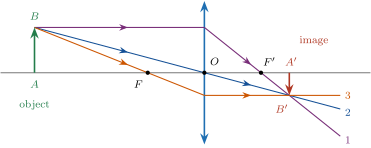
On a diagram, the object is represented by an arrow perpendicular to the optical axis, with point on the axis. Its image is an arrow , also perpendicular to the axis: is the image of , and the image of .
6.2.2 The three special rays
From point , rays leave in all directions. Among those that pass through the lens, there are three whose path is known without any calculation.
- A ray that arrives parallel to the optical axis comes out passing through the image focal point .
- A ray that passes through the optical center goes through the lens without being deviated.
- A ray that arrives passing through the object focal point comes out parallel to the optical axis.
Exercises of the chapter
- Sorting a set of lenses solved
- Focal length and vergence solved
- The image of a candle solved
- The stamp collector's magnifying glass solved
- The eye and the camera solved
- The family's glasses solved