Vibratory nature of sound
Course · Physics (Grade 11 Humanities, Lebanon), chapter 7 · Lebanon, Grade 11 Humanities · the beginning of the chapter, the rest on Adloun
An oud string being plucked, the skin of a darbuka being struck, a voice singing, a phone ringing: all around us, everything is full of sounds. Where do they come from? How do they travel from the instrument to the ear? Why do we see lightning before hearing thunder? And what makes a sound low or high, soft or loud, and what lets us tell an oud from a flute with our eyes closed? This chapter shows that sound is always born from a vibration, that it propagates through matter, and that its qualities can be read on the screen of an oscilloscope.
Curriculum: LB-1H
Required skills
- Know that every sound source is a vibrating object; explain the role of a resonance box.
- Know that sound needs a material medium to propagate and that it does not propagate in a vacuum.
- Describe the propagation of sound in air as a succession of compressions and rarefactions.
- Know the speed of sound in air (about ); know that it is greater in liquids and greater still in solids; use the relation .
- Use a measurement by echo or with two microphones.
- Read the period of a sound on an oscillogram and calculate its frequency .
- Relate the pitch of a sound to its frequency, its loudness to its amplitude and its timbre to the shape of the signal; distinguish a pure sound from a complex sound.
7.1 Every sound source vibrates
7.1.1 Four observations
- The tuning fork. A tuning fork is a small steel fork. When one of its two prongs is struck, it emits a sound. Its prongs seem motionless, but a small light ball hanging from a thread, brought close to a prong, is immediately pushed away: the prong is vibrating very fast. If the prongs are squeezed between the fingers, the vibration stops and the sound stops at the same instant.
- The string. An oud, guitar or violin string that is plucked looks blurred and widened: it moves back and forth very fast on either side of its rest position.
- The membrane. The skin of a darbuka or a drum vibrates when it is struck; grains of sand placed on it hop about. The diaphragm of a loudspeaker does the same: you can feel it vibrate by putting your finger on it.
- The vocal cords. When we speak or sing, fingers placed on the throat feel a vibration: the air coming from the lungs makes two folds located in the larynx vibrate, the vocal cords.
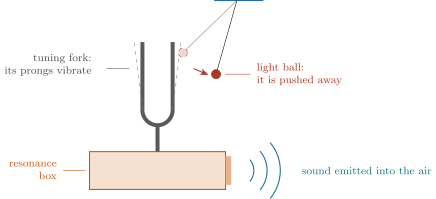
- A vibration is a fast back-and-forth movement of an object on either side of its rest position.
- A sound source is an object that vibrates and passes its vibration on to the medium around it, most often the air.
Every sound is produced by a vibrating object. When the vibration stops, the sound stops.
Musical instruments are in fact classified according to what vibrates: a string (oud, guitar, violin, qanun, piano), a membrane or a plate (darbuka, drum, cymbal), or the air contained in a pipe (flute, nay, clarinet).
7.1.2 The role of the resonance box
A tuning fork held in the hand can barely be heard. Placed on a hollow wooden box, open on one side, it can be heard throughout the room. In the same way, a string stretched between two nails produces a very faint sound, whereas the same string stretched over the rounded body of an oud or a guitar gives a full sound.
The reason is simple: a tuning-fork prong or a string is too narrow to set much air in motion. The box, on the other hand, vibrates with the source, and its large walls, as well as the air it contains, stir a large volume of air.
A resonance box is a hollow box that vibrates with the sound source. Thanks to its large surface, it passes the vibration on to the air much better: the sound is louder.
The resonance box does not create the sound and does not change the note played: it reinforces it. The body of the oud, that of the guitar or the violin, and the shell of the darbuka are resonance boxes. For the voice, it is the mouth, the throat and the nose that play this role.
7.2 The propagation of sound
7.2.1 Sound needs matter: the bell jar
A ringing alarm clock is placed under a glass bell jar, resting on a foam cushion. The bell jar is connected to a pump that can remove the air from it.
- As long as the bell jar is full of air, the ringing is heard clearly.
- When the pump removes the air, the sound gradually weakens, then almost nothing can be heard. Yet the hammer of the alarm clock can still be seen striking.
- If the air is let back in, the sound returns immediately.
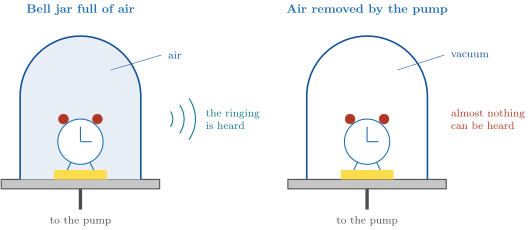
Sound needs a material medium to propagate: a gas (air), a liquid (water) or a solid (a wall, a rail). It does not propagate in a vacuum.
This is a major difference from light, which crosses a vacuum: under the bell jar emptied of its air, the alarm clock can be seen, but it can no longer be heard. In space, two astronauts cannot talk to each other directly.
- With your head under water, at the swimming pool or in the sea, you can hear the engine of a boat or two pebbles being knocked together.
- With your ear pressed against a table, you can hear very well someone scratching the other end of the table.
- You can hear your neighbor through a wall or a door.
7.2.2 How sound travels through air: compressions and rarefactions
Let us observe the diaphragm of a vibrating loudspeaker.
- When the diaphragm moves forward, it pushes the air in front of it: this air is squeezed, it is a compression.
- This squeezed slice of air in turn pushes the neighboring slice, which pushes the next one: the compression is passed on step by step.
- When the diaphragm moves back, it leaves behind it air that is less squeezed: it is a rarefaction, which is passed on in the same way.
The diaphragm vibrates without stopping: it therefore sends into the air a regular succession of compressions and rarefactions, which move away from the loudspeaker.
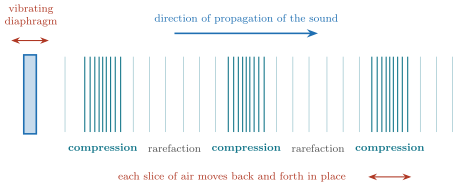
- Sound propagates in air as a succession of compressions and rarefactions that are passed on step by step.
- Each slice of air vibrates in place, back and forth, in the direction in which the sound travels: sound is said to be a longitudinal wave.
- Sound carries energy, but it does not carry matter: the air does not travel from the source to the ear.