The human ear as a sound detector
Course · Physics (Grade 11 Humanities, Lebanon), chapter 8 · Lebanon, Grade 11 Humanities · the beginning of the chapter, the rest on Adloun
The whisper of a secret, the voice of a loved one, a piece of music, the horn warning of danger: it is through the ear that all these sounds reach us. This organ, of which we see only the pinna, hides in the bone of the skull a mechanism of extraordinary delicacy, able to pick up the faintest sound as well as to withstand the din of a building site. How does the ear turn a vibration of the air into a message for the brain? Which sounds does it hear, and which ones escape it? What do decibels measure? And why can a concert that is too loud, or earphones turned all the way up, damage hearing forever?
Curriculum: LB-1H
Required skills
- Name the three parts of the ear and their main organs: pinna, ear canal, eardrum; ossicles (hammer, anvil, stirrup), Eustachian tube; cochlea, hair cells, auditory nerve.
- Describe the path of sound, from the pinna to the brain.
- Know the range of audible frequencies (from to ); place infrasound and ultrasound; name uses of ultrasound (ultrasound imaging, sonar).
- Know that the sensitivity of the ear depends on the frequency of the sound.
- Define the threshold of hearing and the threshold of pain.
- Read a sound level, in decibels, on a scale; know that the level increases by when the sound intensity is multiplied by .
- Know the dangers of noise and the ways to protect your hearing.
8.1 The ear, from the outside in
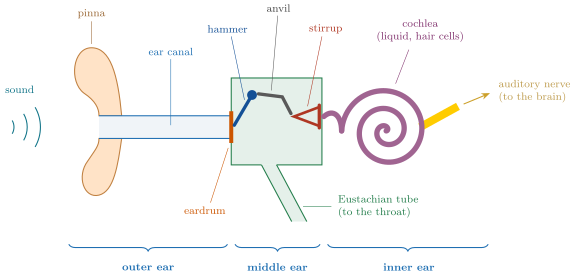
We have seen that a sound is a vibration that propagates in air as a succession of compressions and rarefactions. The ear is the organ that receives this vibration and turns it into a signal that the brain can interpret. It has three parts, which the sound crosses one after the other: the outer ear, the middle ear and the inner ear.
8.1.1 The outer ear: picking up sound
The outer ear is the only visible part. It is filled with air.
- The pinna is the part of the ear that can be seen on each side of the head. Like a funnel, it collects sounds and directs them toward the ear canal. It also helps to tell where a sound comes from.
- The ear canal is a small tunnel about long, which guides sound toward the inside of the head.
- The eardrum closes off the end of the canal. It is a thin, flexible membrane, stretched like the skin of a drum. When the compressions and rarefactions of the air reach it, it starts to vibrate at the same frequency as the sound.
8.1.2 The middle ear: passing on the vibration
Behind the eardrum is a small air-filled cavity, hollowed out in the bone of the skull: the middle ear.
- It is crossed by a chain of three tiny bones, the ossicles. In order, from the eardrum to the inner ear: the hammer, attached to the eardrum, the anvil, then the stirrup, which rests against the entrance of the inner ear. The stirrup is the smallest bone in the human body: it is about three millimeters long.
- When the eardrum vibrates, it drives the hammer, which drives the anvil, which drives the stirrup. The ossicles thus pass on the vibration of the eardrum to the inner ear, while amplifying it.
- The Eustachian tube is a thin channel that connects the middle ear to the back of the throat. It opens when we swallow or yawn, and then lets a little air through: in this way, the pressure stays the same on both sides of the eardrum.
When we drive quickly up into the mountains, or in a plane taking off, the pressure of the outside air decreases. The eardrum, pushed more on one side than on the other, becomes taut: we hear less well, the ear feels “blocked”. By swallowing or yawning, we open the Eustachian tube: the pressures even out and we feel a small “pop” in the ear.
8.1.3 The inner ear: turning the vibration into a nerve signal
The inner ear is housed in the hardest bone of the skull. Its part devoted to hearing is the cochlea, a tube coiled in a spiral like a snail's shell, and filled with liquid.
- As it vibrates, the stirrup sets the liquid of the cochlea in motion.
- All along the cochlea, about hair cells are lined up: cells that carry at their tip a tuft of microscopic hairs. The movement of the liquid makes these hairs move.
- Each hair cell whose hairs move produces an electrical signal. The cells located at the entrance of the cochlea respond to high sounds, those at the far end to low sounds.
- The auditory nerve carries these signals to the brain.
Next to the cochlea, the inner ear also contains the organ of balance: this is why an ear disease can cause dizziness.
8.1.4 The path of sound to the brain

- The pinna picks up the sound; the ear canal guides it to the eardrum.
- The eardrum vibrates.
- The ossicles (hammer, anvil, stirrup) pass the vibration on to the inner ear.
- The liquid of the cochlea starts moving and makes the hairs of the hair cells move; these cells turn the vibration into an electrical signal.
- The auditory nerve carries this signal to the brain, which interprets it: we hear.
So it is the brain that “hears”: the ear picks up, passes on and transforms. If a single link in the chain is damaged (perforated eardrum, blocked ossicles, destroyed hair cells, injured auditory nerve), hearing declines.
8.2 What the ear hears: audible frequencies
8.2.1 Audible sound, infrasound, ultrasound
We know that the pitch of a sound is set by its frequency: low frequency, low sound; high frequency, high sound. But the human ear does not respond to all frequencies. If a loudspeaker is made to emit a higher and higher sound, there comes a moment when nothing can be heard anymore, even though the diaphragm is still vibrating.
- The human ear hears sounds whose frequency is between and (that is, ): these are audible sounds.
- Infrasound consists of vibrations with a frequency lower than : too low, they cannot be heard.
- Ultrasound consists of vibrations with a frequency higher than : too high, they cannot be heard.
Exercises of the chapter
- The hearing chain solved
- The bat and the dog solved
- An ultrasound scan solved
- The faintest sound heard solved
- From the classroom to recess solved
- How long without danger? solved