Periodic motion and waves
Course · Physics (Grade 11, Lebanon), chapter 1 · Lebanon, Grade 11 · the beginning of the chapter, the rest on Adloun
From the regular beating of the heart to the vibrations of an oud string, from the swinging of a pendulum clock to the waves breaking on the Mediterranean shore in Beirut or in Tyre, nature offers a multitude of phenomena that repeat themselves identically at equal time intervals. When such a mechanical vibration arises at a point of a deformable material medium — a stretched string, the surface of water, a spring or a layer of air —, it does not remain confined to its source: it propagates step by step in the form of a progressive mechanical wave, carrying energy and information without carrying matter itself.
This first chapter lays the foundations for the study of vibratory and wave phenomena. We first characterize periodic motion and sinusoidal oscillatory motion by their time period , their frequency , their angular frequency and their amplitude . We then study the propagation of a pulse and of a progressive wave along an elastic medium, the distinction between transverse and longitudinal waves, the speed of propagation , then the double periodicity — in time () and in space (wavelength ) — of sinusoidal progressive waves.
Curriculum: LB-1S LB-1H
Required skills
- Recognize and define a periodic motion as well as a vibratory (oscillatory) motion about a position of stable equilibrium.
- Define and relate the period , the frequency and the angular frequency of a periodic phenomenon.
- Use the time equation of a sinusoidal rectilinear motion and its time recording (elongation, maximum amplitude , initial phase ).
- Explain the phenomenon of persistence of vision () and analyze the stroboscopic observation of a fast periodic motion (apparent stillness for , apparent slow motion in the real or retrograde direction).
- Define a progressive mechanical wave and an elastic medium; distinguish a transverse wave from a longitudinal wave and interpret different oscillograms (sinusoidal, square-wave, sawtooth).
- Explain why a mechanical wave carries energy without any overall transport of matter.
- Define and calculate the speed of a mechanical wave and know the properties of the medium on which it depends (in particular along a stretched string).
- Characterize a sinusoidal periodic progressive wave by its double periodicity in time () and in space (wavelength ).
- Determine experimentally (with two microphones and an oscilloscope) and theoretically whether two points of a medium vibrate in phase () or in phase opposition ().
- Describe the reflection of a pulse at a fixed end (with inversion of sign) or at a free end (without inversion) and apply the laws of reflection of a wave (, conservation of , and ).
1.1 Periodic motion and vibratory motion
1.1.1 Periodic phenomena and periodic motions
In everyday life as in the physics laboratory, many motions repeat themselves regularly: the rotation of the Earth about its own axis, the motion of the hands of a watch, the revolution of a satellite around the Earth or the oscillation of a pendulum.
A motion is said to be periodic if it repeats itself identically (same position, same velocity and same direction of displacement) at regular, successive time intervals.
- The period is the smallest strictly positive duration after which the moving object recovers exactly the same kinematic state. Its unit in the International System (SI) is the second ().
- The frequency (sometimes denoted or ) represents the number of periods (or of complete cycles) performed per second:
It is expressed in hertz (), with .
Mathematically, if a physical quantity describes a periodic motion of period , it satisfies, for every instant and for every natural number :
1.1.2 Oscillatory and vibratory motion
Among periodic motions, some always take place in the same direction of rotation (like the hand of a clock), while others consist of a back-and-forth motion on either side of a fixed position.
A periodic motion is said to be oscillatory (or vibratory when the oscillations are fast and of small excursion) if the moving object performs an alternating back-and-forth motion about a reference position called the equilibrium position .
- The algebraic elongation at instant , denoted (or ), is the abscissa of the moving object measured from the equilibrium position on an oriented axis.
- The amplitude (or ) is the maximum positive value of the elongation:
- A complete oscillation (or a vibration cycle) corresponds to the round trip that brings the moving object back to its initial position with the same velocity and in the same direction. The total travel between the two extreme positions and is (peak to peak), and the moving object covers a total distance equal to during one period .
- A mass hanging from a vertical spring, pulled away from its equilibrium position and then released, oscillates vertically on either side of with a period of the order of ().
- A prong of a tuning fork giving the note A performs complete vibrations per second: its frequency is and its period is .
1.1.3 Sinusoidal time representation
The most fundamental vibratory motion in physics is the sinusoidal rectilinear motion (or harmonic motion), in which the elongation is a sinusoidal function of time.
The elongation of a point moving with a sinusoidal rectilinear motion of period and amplitude about the origin is written:
where:
- is the amplitude of the motion (in );
- is the angular frequency (in radians per second, );
- is the instantaneous phase at instant (in );
- is the initial phase (at ), determined by the initial position and the sign of the initial velocity .
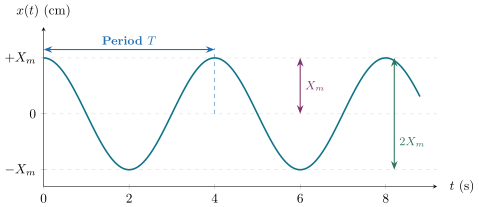
Method : Determining graphically the characteristics of a sinusoidal signal
On the time recording of a sinusoidal vibration:
- Amplitude : read the maximum ordinate reached from the equilibrium axis (or divide by the total peak-to-peak excursion between a minimum and a maximum ).
- Period and frequency : measure the duration separating two consecutive peaks (or two consecutive zero crossings in the same direction). For better precision, measure the duration of complete periods and divide by : , then calculate and .
- Initial phase : read at .
- If (positive peak), then .
- If (negative trough), then .
- If and increases from (), then .
- If and decreases from (), then .
1.1.4 Persistence of vision
When a periodic motion is observed with the naked eye — for example the light spot of an oscilloscope sweeping the screen horizontally, or a white spot painted on the edge of a black disk driven in uniform rotation by an electric motor of adjustable speed —, the perceived appearance changes radically according to the frequency of the motion:
- At low frequency (, that is ): the eye clearly distinguishes the successive positions of the white spot during its rotation (or of the light spot on the screen).
- At high frequency (, that is ): the eye can no longer follow the motion of the spot ; the disk appears to be bordered by a continuous gray-white circular ring (and the spot of the oscilloscope appears as a continuous luminous line).
The luminous impression produced by the image of an object on the retina of the eye does not fade instantaneously when this object disappears or moves: it persists for a duration of about . This physiological phenomenon is called the persistence of vision (persistence of retinal impressions).
It is thanks to persistence of vision that a rapid succession of slightly different still images gives the observer the illusion of a perfectly continuous motion: in the cinema, the projector runs images per second (one image every ); in television and video, the screen displays to complete images per second.
Exercises of the chapter
- Reading a time recording and the time equation solved
- Stroboscopy of a rotating disk and sinusoidal oscillator solved
- Propagation of a transverse pulse along a string solved
- Seismic and waves: determining the distance of an epicenter solved
- Ripple tank: wavelength, in phase and phase opposition solved
- Change of propagation medium (refraction of a mechanical wave) solved