Emission and propagation of sound
Course · Physics (Grade 11, Lebanon), chapter 2 · Lebanon, Grade 11 · the beginning of the chapter, the rest on Adloun
Whether it is the warm timbre of an oud or a qanun, the song of cicadas in the pine forests of Mount Lebanon, the distant rumble of thunder during an autumn storm or the voice of the person we are talking to, the sounds that surround us all arise in the same way: a material object starts vibrating rapidly and communicates this vibratory motion to the fluid or solid medium around it.
This second chapter studies the physical mechanisms of the emission and the propagation of sound waves. We first show that every sound source is a vibrating mechanical system, often coupled to a resonator (resonance box). We then establish that sound is a longitudinal mechanical wave of compression and rarefaction that absolutely requires an elastic material medium in order to propagate — unlike light, which crosses a vacuum. Finally, we analyze the factors that govern the speed of sound in gases, liquids and solids, as well as the phenomena of reflection (echo and reverberation), refraction and absorption of sound.
Curriculum: LB-1S LB-1H
Required skills
- Identify the vibratory nature of every sound source (stretched string, prong of a tuning fork, loudspeaker diaphragm, air column, vocal cords) and explain the amplifying role of the resonance box.
- Describe the structure and the operating principle of the electrodynamic loudspeaker (Laplace electromagnetic force, electroacoustic conversion, matching of the diameter of the diaphragm to the wavelength).
- Interpret the bell-jar experiment and the candle-flame experiment to justify that sound is a longitudinal mechanical wave of compression and rarefaction that does not propagate in a vacuum.
- Carry out the protocol for measuring the speed of sound in air by phase shift on the oscilloscope (), compare the order of magnitude of the speed in gases, liquids and solids () and use the ideal gas law ().
- Define the Mach number and explain the breaking of the sound barrier (shock wave and Mach cone).
- Explain the phenomenon of reflection of sound on an obstacle; distinguish the echo from reverberation () and describe qualitatively the refraction and absorption of sound.
2.1 Emission of sound: vibrating sources and resonators
2.1.1 Vibratory nature of every sound source
Experimental observation shows that no sound can be emitted without the mechanical vibration of a material body:
- If one of the metal prongs of a tuning fork is struck, a pure sound is heard; if a small polystyrene ball hanging from a thread is brought slightly closer, it is sharply pushed away by the rapid vibrations of the prong. As soon as the prongs are pinched with the fingers to stop their vibration, the sound stops instantly.
- When a musician plucks a string of an oud, a guitar or a violin, a blurred spindle is observed, reflecting the rapid transverse motion of the string about its equilibrium position.
- The diaphragm of a loudspeaker supplied with an alternating electric voltage oscillates back and forth at the frequency of the electric signal: grains of sand placed on the horizontal diaphragm jump about as long as the loudspeaker emits a sound.
- When we speak or sing with our fingers placed on the throat at the level of the larynx, we clearly feel the vocal cords vibrating, set in motion by the air exhaled from the lungs.
A sound source is a deformable material system (solid, liquid or gas) undergoing a mechanical vibratory motion of suitable frequency, capable of communicating its vibrations to the surrounding material medium.
Musical instruments and acoustic emitters are usually classified according to the nature of the primary vibrating element:
- vibrating strings: oud, guitar, violin, qanun, piano;
- vibrating blades, membranes and plates: loudspeaker, darbuka, drum, cymbals, tuning fork;
- vibrating air columns (wind instruments): flute (ney), clarinet, organ, whistle.
2.1.2 Role of the resonance box
A metal string stretched between two pegs sealed in a massive wall, or a tuning fork held in the air in the hand, produces a sound that is barely perceptible a few meters away: the surface of the string or of the prongs of the tuning fork is too narrow to set a large volume of air in motion effectively.
On the other hand, when the stem of the tuning fork is placed on an open wooden box (resonance box), or when the strings of an oud are stretched above its rounded body pierced with a rosette, the sound immediately becomes full and powerful.
A resonance box is a mechanical cavity whose walls and internal air column undergo forced vibrations under the action of the primary vibrator (string, prong of a tuning fork, vocal cords coupled to the oral and nasal cavities).
- By offering a large contact surface with the surrounding air, it allows the vibrational energy of the source to be transferred much more efficiently to the air in the form of a sound wave.
- Since the initial mechanical energy of the vibrator (if it is not maintained) is radiated faster, the sound emitted with a resonance box is louder but dies away more quickly than without the box.
2.1.3 The electrodynamic loudspeaker
In hi-fi systems, television sets, telephones or concert halls, the most widespread sound source is the electrodynamic loudspeaker.
1. Structure.
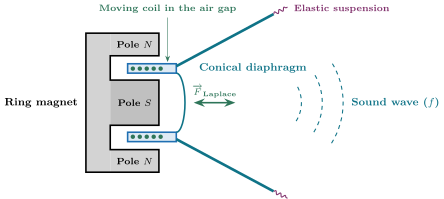
An electrodynamic loudspeaker comprises three essential parts mounted on a rigid metal frame called the basket:
- a ring-shaped permanent magnet creating, in a narrow cylindrical space (the air gap), an intense, permanent radial magnetic field ;
- a moving coil made of a fine copper wire wound on a light cardboard or aluminum cylinder, immersed in the air gap of the magnet and able to slide freely along the axis ;
- a conical diaphragm (made of treated cardboard or polymer), attached to the cylinder of the moving coil and connected to the basket by a flexible elastic suspension (spider) that pulls it back toward its equilibrium position.
2. Operating principle (Laplace electromagnetic force).
When a straight conducting rod , placed between the poles of a U-shaped magnet in a perpendicular magnetic field , carries an electric current , it is subjected to an electromagnetic force (called the Laplace force) perpendicular to the rod and to the magnetic field, whose direction reverses when the direction of the current reverses:
- If a loudspeaker is connected across a battery of DC voltage (), the coil is subjected to a constant force that moves it to one side only, to a new equilibrium position: only a brief “click” is heard when the switch is closed and opened, and then no continuous sound.
- If the moving coil is supplied with an alternating electric voltage of frequency , the current periodically changes direction at the frequency . The Laplace force therefore changes direction at the same frequency , forcing the coil and the conical diaphragm to oscillate back and forth at exactly the frequency of the current (as confirmed by lighting the diaphragm with a stroboscope). By compressing and expanding the adjacent air, the diaphragm emits a sound wave of frequency .
Exercises of the chapter
- From the tuning fork and its resonance box to the sound wave in air solved
- Oud string and sound wave emitted in air solved
- Influence of the temperature and of the molar mass on the speed of sound solved
- Compared propagation in seawater and in air solved
- Condition for a distinct echo and acoustics of a hall solved
- Sonar of a ship moving toward a reef solved