Coulomb's law and electric field
Course · Physics (Grade 11, Lebanon), chapter 10 · Lebanon, Grade 11 · the beginning of the chapter, the rest on Adloun
Since Antiquity, it has been known that a rubbed rod of amber or ebonite attracts small fragments and that two electrified bodies attract or repel each other at a distance according to the sign of the charges they carry. In 1785, Charles-Augustin Coulomb established, with an extremely sensitive torsion balance, that the electrostatic force between two point charges obeys an inverse-square law of the distance, with a mathematical structure analogous to Newton's universal gravitation but with a magnitude incomparably greater at the atomic scale.
To understand how an electric charge acts at a distance on another one without material contact, Michael Faraday introduced in the 19th century the fundamental concept of electric field: every source charge modifies the properties of the space around it by creating at each point an electric field vector , which then locally exerts the force on any test charge placed at that point. This chapter studies in turn Coulomb's law, the electric field vector created by one or several point charges, the uniform electric field that exists between two parallel plane plates subjected to a voltage (), the work of the electrostatic force , as well as the acceleration and the deflection of a beam of charged particles in a uniform electric field.
Curriculum: LB-1S
Required skills
- State and apply Coulomb's law (with in vacuum or in air) to determine the direction, the sense and the magnitude of the electrostatic force between two point charges.
- Define the electric field vector , give its SI unit ( or ) and express the field created by a point charge at the distance ().
- Apply the superposition principle , describe the experimental demonstration of field lines (tank of castor oil and semolina grains) and sketch the shape of the electric field pattern (radial field, uniform field, dipole).
- Characterize the uniform electric field between two plane and parallel metal plates a distance apart and subjected to a voltage : directed from the positive plate toward the negative plate, with magnitude .
- Express the work of the electrostatic force in a uniform field , define the electric potential energy and convert energies between joules () and electronvolts ().
- Study, using the kinetic energy theorem and Newton's second law, the motion of a charged particle accelerated or deflected by a uniform electric field (parabolic trajectory and electrostatic deflection).
10.1 Electrostatic interaction: Coulomb's law
10.1.1 Point charges and statement of Coulomb's law
Two electrified bodies of charges and are said to be point charges if their own dimensions are very small compared with the distance between them. In the International System, electric charge is expressed in coulombs () and every electric charge is an integer multiple of the elementary charge .
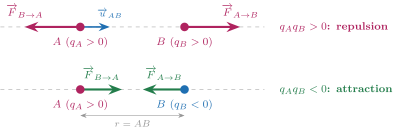
In vacuum (or in air), two point electric charges and placed at two points and a distance apart exert on each other two directly opposite electrostatic forces ():
- Direction: the line joining the two charges;
- Sense: the forces are repulsive if and have the same sign (), and attractive if and have opposite signs ();
- Magnitude: proportional to the absolute value of the product of the charges and inversely proportional to the square of the distance :
where the proportionality constant depends on the insulating medium in which the charges are located. In vacuum (or in dry air), it is expressed in terms of the permittivity of free space by:
Introducing the unit vector directed from toward , the force exerted by on is written in algebraic vector form:
In a homogeneous insulating (dielectric) medium of absolute permittivity , the constant becomes , which reduces the magnitude of the electrostatic interaction compared with vacuum.
In the hydrogen atom, the proton (, ) and the electron (, ) are separated by the mean distance . The electrostatic force of attraction is:
whereas the gravitational force of attraction (with ) is only . The ratio shows that the weight and the gravitational forces are completely negligible compared with the electrostatic force for subatomic particles (electrons, protons, ions).
Exercises of the chapter
- Equilibrium of two identical electrostatic pendulums solved
- Superposition of electric fields on the perpendicular bisector of a dipole and of a pair of like charges solved
- Conducting spheres brought into contact and point of zero field solved
- Uniform field, equipotential surfaces and work along a polygonal path solved
- Electrostatic pendulum in a uniform field: equilibrium and oscillations solved
- Oblique launch of a proton between two horizontal plates (ballistic analogy) solved