Work, power and mechanical energy
Course · Physics (Grade 11, Lebanon), chapter 9 · Lebanon, Grade 11 · the beginning of the chapter, the rest on Adloun
Directly applying Newton's second law () makes it possible to determine the acceleration vector of a moving body at every instant, but it quickly becomes awkward when the trajectory is curvilinear (simple pendulum, roller coaster, circular loop) and the direction of the reaction of the support varies continuously. The energy approach then offers a highly effective scalar method: by replacing the force vectors with their works — algebraic quantities that are zero for any normal reaction perpendicular to the trajectory —, it directly relates the speeds and the altitudes between an initial state and a final state without any need to integrate the time equations of the motion.
This chapter first defines the work and the power of a force in translation and in rotation, then establishes that the work of the weight is independent of the path followed. We then introduce the kinetic energy of a particle, of a solid in translation and of a solid rotating about a fixed axis, and prove the kinetic energy theorem (KET). Finally, the definition of the gravitational potential energy leads to the mechanical energy , whose conservation in the absence of friction and whose decrease in the presence of dissipative forces form one of the pillars of all physics.
Curriculum: LB-1S
Required skills
- Calculate the work of a constant force during a rectilinear displacement and describe this work as driving, resistive or zero.
- Express the work of the weight , the work of a friction force of constant magnitude and the work of a couple of constant moment .
- Calculate the average power and the instantaneous power (or in rotation).
- Express the kinetic energy of a particle (), of a solid in translation () and of a solid rotating about a fixed axis ().
- State, verify experimentally (tilted air table) and apply the kinetic energy theorem in translation and in rotation: .
- Define the gravitational potential energy of a particle () and of an extended solid () with respect to a reference level, as well as the mechanical energy .
- Apply the conservation of mechanical energy () or the mechanical energy theorem () and interpret the transfers between , and the thermal energy dissipated .
9.1 Work and power of a force
9.1.1 Work of a constant force during a rectilinear displacement
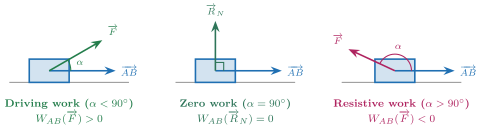
When a constant force (in line of action, direction and magnitude) moves its point of application along a straight segment from to , the work of the force during the displacement , denoted , is the scalar product of the force vector and the displacement vector :
where is the geometric angle between the vectors and . In the International System, work is expressed in joules (, with ).
Work is an algebraic quantity whose sign depends on the angle :
- If (): . The force favors the displacement: its work is said to be driving (and maximum for , where ).
- If (): . The force opposes the displacement: its work is said to be resistive (for , ).
- If (, that is ): . Any force that is always perpendicular to the trajectory (normal reaction of a fixed frictionless support, tension of the string of a simple pendulum) does zero work.
9.1.2 Elementary work, work of the weight, of friction and of a couple in rotation
When the trajectory between and is curvilinear or the force varies along the path, the curve is divided into infinitesimal displacements that can be treated as straight segments over which is practically constant: the elementary work is , and the total work is the sum of these elementary works.
1. Work of the weight in a uniform gravitational field. In a coordinate system whose axis is vertical and upward ( and ), the work of the weight of a body of mass whose center of mass goes from to is independent of the path followed and depends only on the difference in height :
The weight is said to be a conservative force.
2. Work of a friction force of constant magnitude . If a friction force is at every point tangent to the trajectory, opposite in direction to the velocity vector ( over each elementary displacement ) and of constant magnitude , its work over a path of total curvilinear length is always resistive and depends on the path followed (non-conservative force):
3. Work of a force or a couple of constant moment on a rotating solid. When a solid turns through an angle (in radians) about a fixed axis under the action of a force (or a couple) of constant moment , the point of application located at the distance describes an arc and the work is:
9.1.3 Average power and instantaneous power of a force
- The average power of a force that does the work during the time is the quotient:
- The instantaneous power of a force at the instant , when its point of application moves with the velocity , is:
- For a solid rotating at the angular velocity about a fixed axis , the instantaneous power of a force or a couple of moment is:
In the International System, power is expressed in watts (, with ). In electrical engineering, the kilowatt-hour is also used as a unit of energy: .
Exercises of the chapter
- Accounting for works, driving power and emergency braking of a truck solved
- Toppling of a vertical bar and compound pendulum solved
- Systems of bodies coupled by a string and a pulley solved
- Simple pendulum: speed, maximum tension of the string and breaking at the lowest point solved
- A skier leaving the top of a hemispherical mound (igloo) solved
- A puck going back and forth between a rough inclined plane and a smooth ramp solved