Rotational dynamics and equilibrium of a solid
Course · Physics (Grade 11, Lebanon), chapter 8 · Lebanon, Grade 11 · the beginning of the chapter, the rest on Adloun
To open a heavy door or loosen the nut of a wheel with a wrench, the magnitude of the force exerted is not enough: the action is more effective when the force is applied far from the hinges or from the axis of the nut and perpendicular to the door or to the handle of the wrench. Conversely, two opposite forces of the same magnitude applied at the two ends of a car steering wheel have a zero vector resultant (), but they nevertheless make the steering wheel rotate: the condition , sufficient for the equilibrium of a material point, is no longer enough to guarantee the equilibrium of an extended solid.
This chapter first distinguishes the translational motions (rectilinear, curvilinear, circular) and the rotational motion about a fixed axis of a rigid solid, then introduces the moment of inertia , which measures the rotational inertia of the solid about . After defining the moment of a force about an axis and the moment of a couple, we establish Newton's second law for a solid rotating about a fixed axis (), and then deduce from it the two general conditions for the equilibrium of a solid ( and ).
Curriculum: LB-1S
Required skills
- Distinguish the translational motion (rectilinear, curvilinear, circular) from the rotational motion about a fixed axis of a rigid solid, and relate the linear quantities (, , ) to the common angular quantities ().
- Define the moment of inertia of a particle or of a system of particles about an axis , use the moments of inertia of common homogeneous solids (table in section 8.2) and apply Huygens' theorem .
- Define the lever arm of a force orthogonal to an axis and calculate its algebraic moment after choosing a positive direction of rotation.
- Identify the cases in which the moment of a force about is zero (line of action parallel to or intersecting ) and apply Varignon's theorem.
- Define a couple of forces, calculate its moment (independent of the position of the axis) and express the moment of the restoring couple of a torsion wire .
- State and apply Newton's second law for a solid rotating about a fixed axis (), characterize uniformly varied rotational motion () and study coupled translation-rotation systems (massive pulley, Atwood machine).
- State and apply the two general conditions for the equilibrium of a solid ( and ) to determine the tension of a string and the reaction of an axle or of a support.
8.1 Translational and rotational motions of a solid
8.1.1 Translational motion: rectilinear, curvilinear and circular
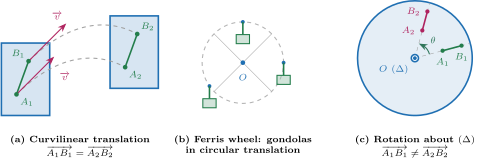
A rigid solid is in translational motion when every segment joining any two points and of the solid remains parallel to itself during the motion ( between any two instants and ).
- During a translation, all the points of the solid travel the same distance during the same time interval and have, at every instant , the same velocity vector and the same acceleration vector as the center of mass .
- A translational motion is not necessarily uniform: the magnitude and the direction of the common velocity vector may vary over time.
Depending on the geometric shape of the trajectories described by the various points of the solid (which can all be obtained from one another by a translation of vector ), three categories of translation are distinguished:
- Rectilinear translation: the trajectories of all the points of the solid are parallel straight lines (examples: an elevator car in its vertical shaft, or a crate sliding without tipping along a horizontal or inclined plane).
- Curvilinear translation: the trajectories of all the points are arbitrary superimposable curves (example: the cable car linking Jounieh to Harissa, which follows the curved profile of the carrying cable while always remaining vertical).
- Circular translation: the trajectories of all the points of the solid are circles of the same radius, but the solid keeps a fixed orientation in space (every segment stays parallel to itself). The emblematic example is that of the gondolas of a Ferris wheel: while the structure of the Ferris wheel rotates about its central axis, each gondola hanging at the rim keeps its floor horizontal and its walls vertical throughout the complete turn — it therefore undergoes a circular translation!
8.1.2 Rotational motion about a fixed axis and general motion
A rigid solid is in rotational motion about a fixed axis (a line fixed in the frame of reference of study) if:
- all the points of the solid located on the line remain motionless over time;
- every other point of the solid describes a circle centered on the axis (at its orthogonal projection onto ), of radius , and lying in the plane perpendicular to that passes through .
Unlike the case of translation, a segment of the solid not parallel to does not stay parallel to itself during a rotation: it turns through the same angle as all the radius vectors during the time interval .
When a rigid solid rotates about a fixed axis , its position is located at every instant by its angular abscissa (in ):
- At every instant, all the points of the solid have the same angular velocity (or ) and the same angular acceleration (or ):
If the rotation is uniform with period (in ) and frequency (in or ), then and .
- A point of the solid located at the orthogonal distance from the axis travels the arc ; its linear speed and the tangential component and normal (centripetal) component of its acceleration are:
In everyday life, the most general motion of a rigid solid is a combination of a translational motion and a rotational motion: this is the case, for example, of the wheel of a car rolling along a road, or of a cylinder or a ball rolling down an inclined plane (the center of mass undergoes translation while the solid simultaneously rotates about the axis passing through ).
A circular turntable of radius rotates about its axis of revolution at the constant rate of , that is . Its angular velocity is . A point located halfway along the radius () has the linear speed , while a point on the rim () goes twice as fast: .
8.2 Moment of inertia of a system and of a solid about an axis
8.2.1 Physical evidence of rotational inertia
In point mechanics, when the same force acts on two particles of different masses , their accelerations satisfy , that is : the greater the mass, the weaker the effect of the force. The mass therefore measures the translational inertia of a body.
Similarly, two different solids free to move about a fixed axis and subjected to the same turning action do not acquire the same angular acceleration: they have different rotational inertias about . Experiment shows that this rotational inertia depends not only on the total mass of the solid, but above all on the distribution of this mass with respect to the axis of rotation : it is much harder to set a wheel rotating (or to brake it) when its mass is concentrated far from the axis on its outer rim than when it is gathered near the central hub.
8.2.2 Moment of inertia of a particle and of a system of particles
The rotational inertia of a material system about an axis is measured by a positive scalar quantity called the moment of inertia about and denoted :
- For a point particle of mass located at the orthogonal distance from the axis :
- For a discrete system of particles of masses located respectively at the orthogonal distances from the axis :
For a given rigid solid, the moment of inertia depends on the choice of the axis , but stays constant during the motion about a given axis .
Direct calculation of the moment of inertia of a homogeneous hoop. Consider a hoop (very thin circular ring) of mass and radius , and take as the axis its axis of revolution (perpendicular to the plane of the hoop at its center ). Every mass element of the hoop is located at the same distance from the axis ; its elementary moment of inertia is . Summing over all the elements of the hoop:
Exercises of the chapter
- Rotational kinematics of a belt drive and moments on a winch solved
- Calibrating a torsion wire and combining two wires solved
- Moment of inertia of a system of particles, of a half-hoop and of a flywheel with holes solved
- Equilibrium of a rod on a knife edge and of an inclined bar hinged on a wall solved
- Cylinder held in equilibrium on an inclined plane by a horizontal string solved
- Atwood machine with a massive pulley: Newton's second law in translation and in rotation solved