Systems of particles and center of mass
Course · Physics (Grade 11, Lebanon), chapter 7 · Lebanon, Grade 11 · the beginning of the chapter, the rest on Adloun
When a diver performs a somersault, when the fragments of a firework explode in the sky or when the Earth--Moon system describes its orbit around the Sun, each part of the system has its own motion, which is often complex. Yet every material system contains a privileged point — the center of mass (or center of inertia) — whose trajectory remains strikingly simple: everything happens as if the total mass of the system were concentrated there and subjected only to the resultant of the external forces.
This chapter extends the mechanics of the material point to systems made up of several particles or several solids, whether rigid or deformable. After distinguishing internal forces (whose resultant is always zero by virtue of the principle of reciprocal actions) from external forces, we define the center of mass geometrically as the barycenter of the masses and present the methods for locating it in composite or hollowed-out systems. We then introduce the linear momentum vector and establish the center-of-mass theorem as well as the law of conservation of linear momentum of an isolated or pseudo-isolated system, a fundamental tool for analyzing the recoil of a gun, jet propulsion, the bursting of a projectile or the displacement of a person in a boat.
Curriculum: LB-1S
Required skills
- Define a system of particles, distinguish a rigid system from a deformable system and classify forces as internal forces and external forces.
- Prove, using Newton's third law, that the vector sum of the internal forces of a material system is zero: .
- Define the center of mass by the barycentric relation and calculate its coordinates in a Cartesian coordinate system.
- Use the symmetry and the associativity of the barycenter to determine the center of mass of a composite system or of a homogeneous solid with a cavity (method of negative masses).
- Express the linear momentum vector of a system and prove the fundamental relation .
- State and apply the center-of-mass theorem .
- Use the conservation of the linear momentum vector () and the immobility or uniform rectilinear motion of for an isolated or pseudo-isolated system (recoil, explosion, boat).
7.1 Material system: internal forces and external forces
7.1.1 System of particles, rigid solid and deformable system
A material system is a finite set of particles (or material points) of respective masses . The total mass of the system is the arithmetic sum of the masses that make it up:
- The system is said to be rigid (or a rigid solid) if the distance between any two points of the system remains strictly constant over time: .
- The system is said to be deformable if the mutual distances between its constituents can vary during the motion (examples: the system \{cannon + shell\} during firing, a skater pulling in her arms, a gas contained in a vessel, a projectile bursting in flight).
Choosing the boundaries of the system studied is the first step of any mechanics problem: the same force can be internal or external depending on the definition adopted for .
7.1.2 Classification of forces and zero internal resultant
Once a material system has been delimited in thought:
- An internal force, denoted (or ), is any force exerted by a particle belonging to the system on another particle also belonging to ().
- An external force, denoted , is any force exerted on a particle of the system by a body not belonging to (the surroundings).
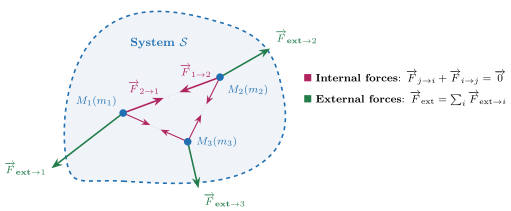
For any material system (whether rigid or deformable, at rest or in motion), the vector sum of all the internal forces is identically zero:
Proof
Consider two distinct particles and of the system . According to Newton's third law (principle of reciprocal actions), the force exerted by on and the force exerted simultaneously by on have the same line of action , the same magnitude and opposite directions:
When all the internal forces acting on all the particles of are added up, these forces group in pairs of mutual interaction , each of which is zero. The overall resultant of the internal forces is therefore always equal to the zero vector.
The fact that does not mean that the internal forces have no physical effect: since is applied at and at , they can deform the system (explosion of a shell, release of a spring compressed between two carts) and change the kinetic energy of each constituent. On the other hand, they can never, on their own, change the overall motion of the center of mass of the system.
A solid hangs from the ceiling by an inextensible string , and a second solid hangs below by means of a spring . Let us classify the forces according to the boundary chosen for the system :
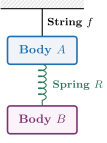
- System : external forces: weight (exerted by the Earth), tension of the string and tension of the spring .
- System : external forces: weight and tension of the spring .
- System : the mutual forces and become internal (); the external forces are , the weight of the spring and the force exerted by on the upper end of the spring.
- Overall system : all the forces exerted by the spring on and (and vice versa) are internal and their sum is zero; the only external forces are the total weight and the tension exerted by the upper string .
Exercises of the chapter
- Center of mass of a triatomic molecule and of a weighted rod solved
- Composite plate and homogeneous disk with a cavity solved
- Motion of the center of mass of two moving bodies and separation by a spring solved
- A fisherman walking on a boat and jumping from the stern solved
- Recoil of a cannon on an inclined plane and compression of a recoil brake solved
- Decay of a nucleus at rest and planar bursting into three fragments solved